Complete 2026–27 technical rules.
Cover text
2026-2027 Technical Rules of The Louisiana High School Powerlifting Association Edited by The Louisiana High School Powerlifting Association Executive Committee, August 23, 2026
Table of contents
Page numbers below follow the document’s printed contents. Select a heading to jump to its location in this edition.
Contents · Page 2
- I. General Rules8
- A. Competition8
- B. State and Regional Championship Meets8
- C. Body Weight Categories8
- 1. Recognized titles for each weight category:8
- a) Men8
- b) Women8
- D. Composition of a Team8
- E. Team and Individual Weight Class Awards: State and Regional Meets9
- 1. Team Awards: LHSAA/LHSPLA State Meet9
- 2. Team Awards: LHSPLA Regional Meets9
- 3. Individual Awards: LHSAA/LHSPLA State Meet9
- 4. Individual Awards: LHSPLA Regional Meets10
- F. Round System10
- G. Pound Weight in LHSPLA Sanctioned Competitions10
- H. Attire10
- I. Emblems, Logos, Etc.10
- J. Team Roster Submission at A Meet10
- II. Equipment and Specifications11
- A. Platform:11
- 1. Size11
- 2. Surface11
- 3. Boundaries of the Lifting Area11
- 4. Allowable Personnel on Platform12
- B. Bars and Discs12
- 1. General Description12
- 2. Competition Bar12
- 3. Bar Specifications12
- 4. Plate Specifications13
- 5. Collars: Use and Specifications13
- C. Squat Racks13
- 1. Construction and Stability13
- 2. Height of Racks (Maximum and Minimum)13
- 3. Height Adjustment14
- 4. Securing of Racks by Pins14
- 5. Rack Width Settings14
- 6. Squat Racks in Warm-Up Room14
- D. Bench Press14
Contents · Page 3
- 1. Dimensions14
- 2. Recommended Bench for Warm-Up Room15
- E. Lights15
- 1. Providing of Lights15
- 2. Officials’ Control of Lights15
- 3. Arrangement of Lights15
- 4. Controlling of Master Switch15
- 5. When Lights Are Not Wired to Light Up Simultaneously15
- 6. Electrical Breakdown15
- III. Costume and Personal Equipment16
- A. Approved Supportive Equipment16
- B. Costume (Lifting Suit)17
- 1. General Rule17
- 2. Specific Rule17
- C. Shirt18
- 1. General Rule18
- 2. Specific Rule18
- D. Socks18
- 1. Allowable Socks18
- 2. Length of Socks18
- 3. Full Length Stockings18
- 4. Shin Length Socks19
- E. Religious Exemption on Costume19
- F. Athletic Supporter/Briefs19
- G. Women’s Wear Beneath the Lifting Suit20
- 1. Undergarments20
- H. Belt20
- 1. Wearing a Belt20
- 2. Materials and Construction20
- 3. Dimensions20
- I. Foot Attire on The Platform21
- 1. General Rule21
- 2. Definition of Soles21
- 3. Exclusions21
- J. Wraps21
- 1. General Rule21
- 2. Legal Use of Wraps21
- 3. Illegal Use of Wraps22
- K. Knee Sleeves22
Contents · Page 4
- 1. Knee Sleeve Construction22
- 2. Knee Sleeve Dimensions22
- 3. No Additional Strapping22
- 4. No Contact When Worn22
- L. Equipment Waiver Enforcement at Meets22
- 1. Coaches Inspection of Team Equipment22
- 2. Consequences for Major and Minor Equipment/Attire22
- 3. Repeated Use of Invalid Equipment (Major/Minor)23
- LHSPLA EQUIPMENT WAIVER24
- M. Major Rule Infractions: Costume and Equipment25
- N. Minor Infractions: Costume and Equipment25
- O. Prohibited and Acceptable Items/Accessories26
- P. Use of Substances on The Lifter or On the Lifter’s Attire/Equipment26
- 1. Forbidden Substances26
- 2. Allowable & Prohibited Substances26
- IV. The Powerlifts and Rules of Performance28
- A. Squat28
- 1. Rules of Performance28
- a) One Minute Rule28
- b) Starting Position28
- c) Removing Bar from Rack28
- d) Execution of the Squat29
- e) Recovery Phase of Lift29
- f) Bona Fide Attempt to Return the Bar to the Rack29
- g) Number of Spotters/Loaders on Platform30
- h) Allowable Spotter/Loader Assistance30
- i) Spotter Error, Equipment Failure, Disarrangement of Platform30
- j) Grip Choices (Squat ONLY)30
- k) Mandatory Halting on the Platform30
- 2. Cause for Disqualification31
- B. Bench Press32
- 1. Rules of Performance32
- a) Placement of Bench on Platform32
- b) Bench Rack Height32
- c) Lifter’s Position on Bench32
- d) Use of Blocks, Etc. to Assure Firm Footing32
- e) Allowable Number of Spotters/Loaders32
- f) Spacing of Hands on Bar32
- g) Use of Closed Grip32
Contents · Page 5
- h) One Minute Rule33
- i) Starting Position of Lift33
- j) Recovery Phase of Lift (Press Command)33
- k) Rack Command33
- l) Downward Movement33
- m) Allowable Use of Small Belt33
- 2. Causes for Disqualification34
- C. Deadlift34
- 1. Rules of Performance34
- a) Starting Position – One Minute Rule34
- b) Lifter’s Position in Regard to the Head Official35
- c) Position at the Completion of the Lift35
- d) Official’s Signal at the Completion of the Lift35
- e) Definition of an Attempt35
- f) Use of Closed Grip35
- 2. Causes for Disqualifications35
- V. Weighing In36
- A. LHSPLA 24 Hour Rule36
- B. Duration of Weigh-In Sessions36
- 1. Specification of Weigh-In Times at LHSPLA Meets36
- C. Weigh-In Procedure36
- 1. Where and Who May Attend36
- 2. Lifter Requirements36
- 3. Who May Be Present at the Weigh-In36
- D. Determining the Order of Lifting37
- E. Explanation of Officially Making Weight37
- 1. Procedures to Follow if Weight is Made – Initial Expeditor Card37
- 2. Lifter’s Responsibility When Making Weight37
- 3. Illegal Re-Weigh38
- F. Weigh-Ins at Invitationals and Dual/Tri Meets38
- G. A Lifter Is Too Heavy/Light for The Class Declared (Regional Competition)38
- H. When Lifters Have A Tie in Their Totals38
- 1. Re-Weigh Procedures38
- 2. Lifters Re-Weighing the Same38
- I. Scoring at All Meets38
- J. Lifter Information to Be Presented at the Weigh-In and Allowable Attempt Changes39
- 1. Conventional Bar Progression39
- 2. Minimum Acceptable Opening Attempt39
- K. The Rounds System as Recommended for LHSPLA Meets39
Contents · Page 6
- 1. Submission of 1st Attempts39
- 2. Submission of 2nd Attempts39
- 3. Attempt Changes in the Deadlift39
- 4. Declare Next Attempts to the Expeditor40
- 5. Declaration of Attempt When Lifter Follows Himself/Herself40
- 6. Repeat Attempts Procedure40
- 7. Order of Attempts by Increasing Weight40
- 8. Allowable 2nd and 3rd Round Attempts40
- 9. 5 lb. Increase40
- VI. MEET OFFICIALS AND ORDER OF COMPETITION40
- A. Officials to be Appointed40
- 1. By Regional/State Meet Director40
- B. Jurisdiction of Meet Officials41
- C. Persons/Officials Allowed on the Platform41
- 1. During Competition on Stage/Platform41
- 2. Adult at Expeditor Table41
- 3. Penalties for Supervision on Platform by Uncertified Coach41
- D. Persons/Coaches Allowed in the Wrapping Area41
- E. Adjusting of Equipment While on the Platform41
- F. Progressive Loading of the Bar41
- G. Order of Lifters Taking the Same Weight42
- 1. Use of Bodyweight to Determine Lifting Order42
- 2. Attempt Priority Rule42
- H. Minimum Amount of Weight Increase Between Successful Attempts42
- 1. Standard Procedure42
- 2. Allowance of Record Attempts42
- 3. State Records – Simultaneous Breaking of Records at Different42
- Regions42
- I. Loading Errors and Incorrect Announcements by the Announcer42
- 1. Responsibility for Corrective Action42
- 2. Examples of Errors in Loading and Proper Correction Measures43
- a) Bar is Loaded to a Lighter Weight43
- b) Bar is Loaded to a Heavier Weight43
- c) Displacement of Bar or Equipment on Platform43
- d) Speaker Error43
- e) Bar is Misloaded44
- f) Lifter Lifts Out of Order by Own Fault44
- g) 3rd Attempt Deadlift44
- J. Disqualification for Failure to Successfully Make an Attempt in Each of The Three Contested Lifts44
Contents · Page 7
- K. Allowable Spotter Aid44
- L. Lifter Time Allotment for Removal from The Platform Following an Attempt44
- M. Disqualification Procedure for Misconduct44
- 1. Conduct That Discredits the Sport44
- 2. Contact Above the Neck and Shoulders45
- N. Appeals or Complaint Procedure45
- 1. Rule for Presentation of Appeals or Complaints45
- 2. Head Official or Meet Director’s Authority for Formal Complaints45
- O. Break Time Between Each Contested Lift46
- P. Recommended Size of Flights Using the Rounds System46
- 1. Number of Lifters in a Flight46
- 2. When Fewer than 10 Lifters are in a Flight46
- VII. Officials46
- A. Jurisdiction of Meet Officials46
- B. Duties of the Head Official46
- C. Procedure for Announcing the Platform Officials’ Decision46
- D. Signals for the Three Lifts46
- E. Unwitnessed Lift47
- F. Duties of the Officials47
- 1. During the Contest47
- G. Lifter Notification of Infraction(s)47
- H. Non-Influence of Officials Toward Each Other48
- I. Acceptable Official Communication48
- J. Official’s Duties After the Competition48
- K. On-Deck Official’s Inspection48
- L. Timekeeper – Duties48
I. General Rules
A. Competition
The Louisiana High School Powerlifting Association (LHSPLA) recognizes the following lifts, which shall be taken in all three-lift competitions conducted under the sanction of the LHSPLA:
Lifts and Sequence:
1. Squat
2. Bench Press
3. Deadlift
NOTE: A combination of the best lift in each of the above three lifts (excluding fourth attempts will constitute the TOTAL.
B. State and Regional Championship Meets
The LHSPLA conducts and sanctions the following meets and maintains State Records for:
The North, South, East, West, Central, and Bayou Regional Championship Meets and the State High School Powerlifting Championship.
C. Body Weight Categories
1. Recognized titles for each weight category:
| a) Men | b) Women |
|---|---|
| Up to 114.5 lbs. | Up to 97.0 lbs. |
| 123.5 lbs. | 105.8 lbs. |
| 132.3 lbs. | 114.5 lbs. |
| 148.8 lbs. | 123.5 lbs. |
| 165.3 lbs. | 132.3 lbs. |
| 181.8 lbs. | 148.8 lbs. |
| 198.3 lbs. | 165.3 lbs. |
| 220.3 lbs. | 181.8 lbs. |
| 242.5 lbs. | 198.3 lbs. |
| 275.5 lbs. | 220.3 lbs. |
| Over 275.5 lbs. | Over 220.3 lbs. |
D. Composition of a Team
Each men’s team is allowed a maximum of eleven (11) competitors spread throughout the range of the eleven (11) bodyweight categories, and each women’s team is allowed eleven (11) competitors spread throughout the range of the eleven (11) bodyweight categories for women. There shall not be more than two competitors from any one team
View page layout · 8
in any particular bodyweight category. All teams shall be officially registered with the LHSPLA to engage in team competition.
E. Team and Individual Weight Class Awards: State and Regional Meets
1. Team Awards: LHSAA/LHSPLA State Meet
a) Team awards shall be given to the State Champion and the State Runner-Up in each Division (I-V) at the State Meet. Also, 1st place team medals for boys/girls Division I – Division V team championships – 11 medals per team, and 2nd place team medals for boys/girls Division I – Division V team runners-up – 11 medals per team will be awarded.
b) At both the regional and state level of team competition, if there is a scoring tie between one or more schools, the team with the higher number of 1st place finishers will be awarded the higher place. If a tie still exists, then the team with the higher number of 2nd place finishers will be awarded the higher place. This tiebreaker will be utilized up to and including a team’s 5th place finisher all scoring places (1st through 10th), if necessary, to break the tie in a team score. If this does not resolve the problem, then total team Wilks coefficient should be utilized.
c) The size and make-up of the team trophies at the State Meets are to be made up to the prescribed specifications of the LHSAA Executive Committee.
2. Team Awards: LHSPLA Regional Meets
Trophies will be given to the top two teams, no matter what classification, at Regional competitions. The size and make-up of the team trophies at the Regional Meets are to be made up to the prescribed specifications of the LHSPLA Executive Committee.
3. Individual Awards: LHSAA/LHSPLA State Meet
Medals will be awarded to the top three (3) lifters in each weight class at the LHSPLA State Meet. Outstanding lifter trophies for the light and heavy platforms at both the boys’ and girls’ meet will be awarded in all Divisions (I-V). The size and make-up of the medals, individual trophies and certificates at the State Meets are to be made up to the prescribed specifications of the LHSAA Executive Committee.
The girls’ outstanding lifter trophies (Division I-V) at the State Meet will be divided in the light and heavy platforms using the following criteria:
Light Platform: 97 lb. – 148.8 lb. Weight classes Heavy Platform: 165 lb. – SHW Weight classes
The boys’ outstanding lifter trophies (Division I-V) at the State Meet will be divided into the light and heavy platforms using the following criteria:
View page layout · 9
Light Platform: 114 lb. – 165 lb. Weight classes Heavy Platform: 181 lbs. – SHW Weight classes
4. Individual Awards: LHSPLA Regional Meets
The top three (3) lifters in each weight class will receive a medal. Also, the outstanding lifters on the light and heavy platforms will be presented outstanding lifters awards. The size and make-up of the individual awards at the Regional Meets are to be made up to the prescribed specifications of the LHSPLA Executive Committee.
F. Round System
It is recommended that the Round System be used at all meets, as it is more expedient for the lifters and meet administrators.
G. Pound Weight in LHSPLA Sanctioned Competitions
All LHSPLA meets shall be conducted with pound weights. Said weights should be uniform in make and size. Bars used in LHSPLA competitions should also be uniform 45 pound Olympic weightlifting bars with sufficient knurling.
H. Attire
Lifters in LHSPLA meets should have the option of lifting in either a one-piece lifting suit or singlet. A shirt with a hemmed sleeve that does not go past the elbow must be worn. With either attire, shoes with a molded sole are mandatory.
I. Emblems, Logos, Etc.
Any emblem or logo may be worn on a lifting shirt, equipment, belt, and attire as long as it is not obscene or profane, or deemed as interfering with the platform official’s job of making decisions as to the validity of a lift.
J. Team Roster Submission at A Meet
Each team will submit a team roster to the Regional Meet Director adhering to the due dates for required paperwork and submission of entries listed in Section 17 – Powerlifting of the LHSAA handbook. Due dates are listed according to respective Regional and State Meet competitions. Meet Directors must receive a team’s roster before they will be allowed to weigh-in at a Regional or State Meet competition. Only the lifters listed on this roster will be allowed to lift in the Regional Meet. No new names may be added to this roster after the entry form deadline.
View page layout · 10
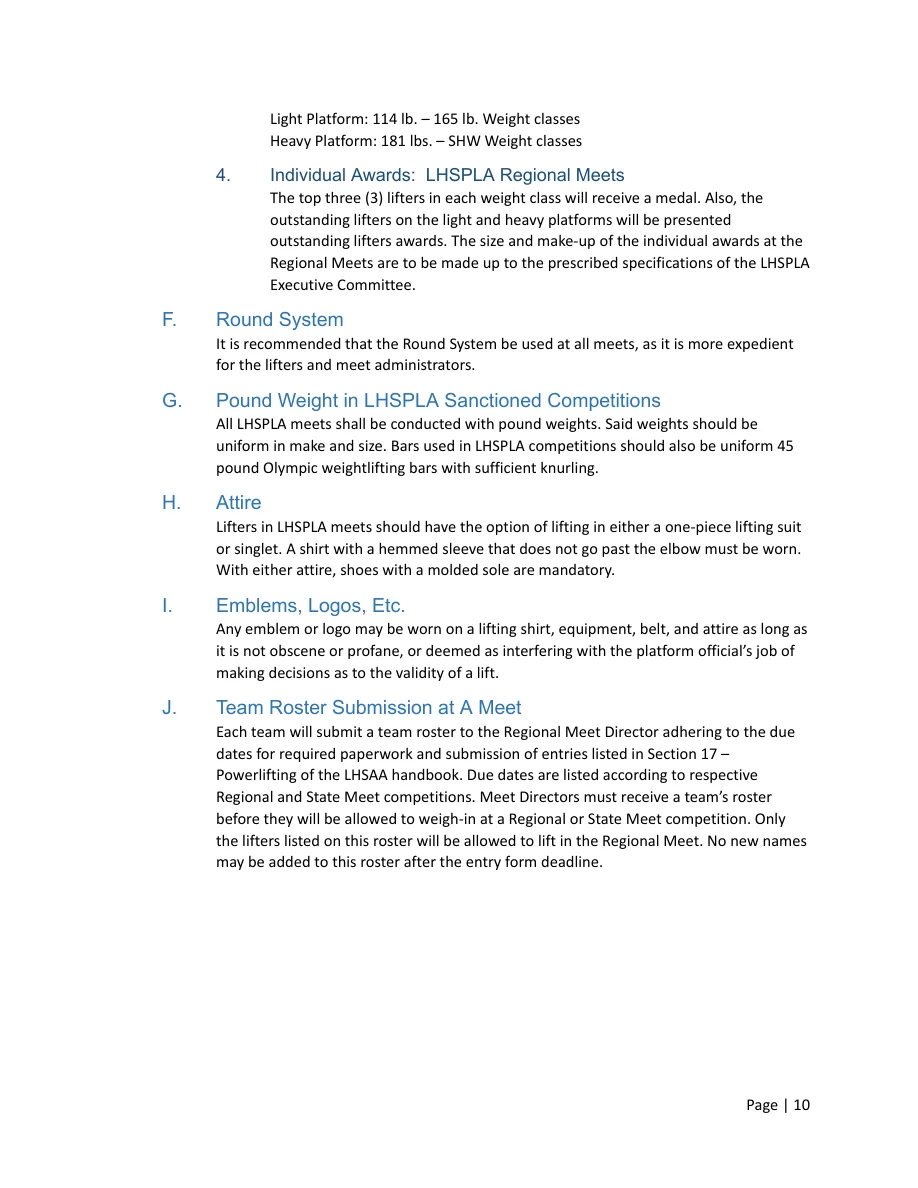
II. Equipment and Specifications
A. Platform:
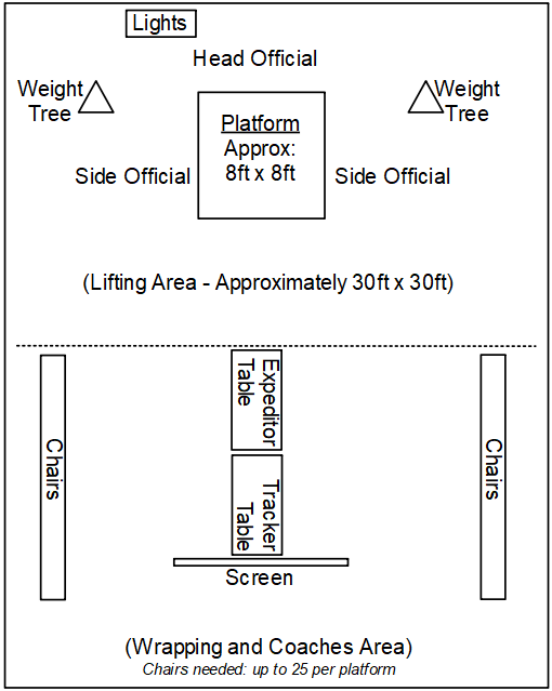
1. Size
It is recommended that all lifts shall be performed on a platform measuring 8 ft. x 8 ft. for a minimum (Regional Meets) and up to 12 ft. x 12 ft. for a maximum (State Meet).
2. Surface
It is recommended that the surface of the platforms shall be firm, non-slip, and level, and shall not exceed 4 inches in height from the surrounding floor. No discernable seams are permitted in the general vicinity of the lifter. All actual lifting (where the lifter stands) shall be on a 4x8 ft. sheet of plywood (or equivalent rubber mat).
3. Boundaries of the Lifting Area
The boundaries of the lifting area should be clearly marked for the benefit of the coaches, officials, and spotters. This can be done with broad tape, barriers of
View page layout · 11
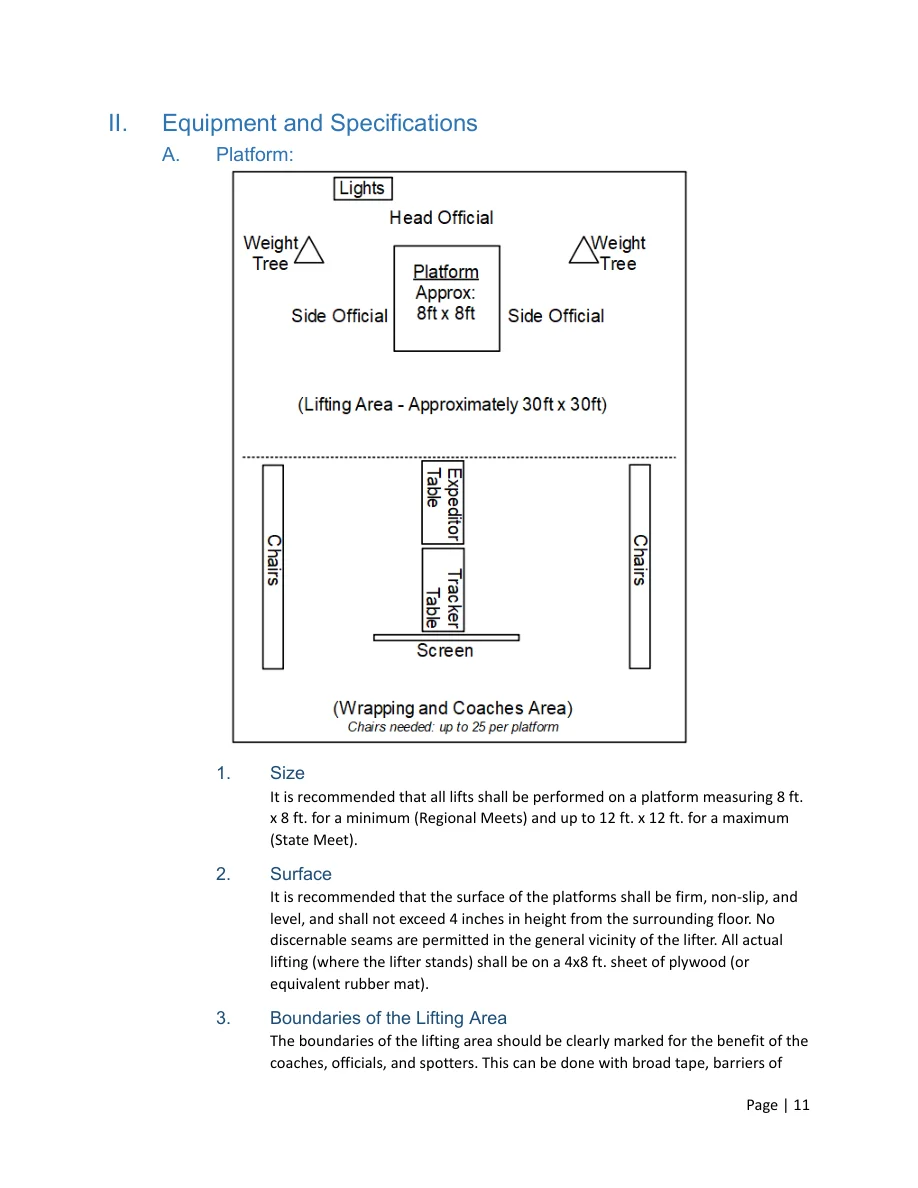
flags or rope, etc. This determines the vicinity of the platform, or the area in which there can be NO COACHES or NO SPECTATORS.
4. Allowable Personnel on Platform
No one is allowed on the platform except the lifter, the designated loaders and/or spotters, the platform officials, and other meet officials. Any cleaning, mopping, brushing, or adjusting on the platform shall be handled solely by these official personnel unless otherwise designated by the Head Official or Meet Director.
B. Bars and Discs
1. General Description
It is recommended for all powerlifting contests organized by the LHSPLA, only disc barbells are permitted. The use of bars or discs that do not meet the recommended specifications will invalidate the contest or any records accomplished.
2. Competition Bar
General rule on type of bar allowed:
It is recommended that competition bars be of the Olympic type, and not the standard exercise bar.
3. Bar Specifications
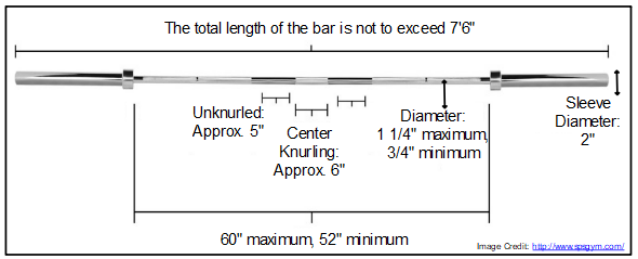
It is recommended that the bar be straight, well knurled or grooved, and conform to the following dimensions for all LHSPLA sanctioned meets. (See Appendage I LHSPLA Constitution)
a) Total length not to exceed 7’ 6”.
b) Distance between the collar faces shall not be less than 52 inches or more than 60 inches.
c) Diameter of the bar shall not exceed 1 ¼” or be less than ¾”.
View page layout · 12
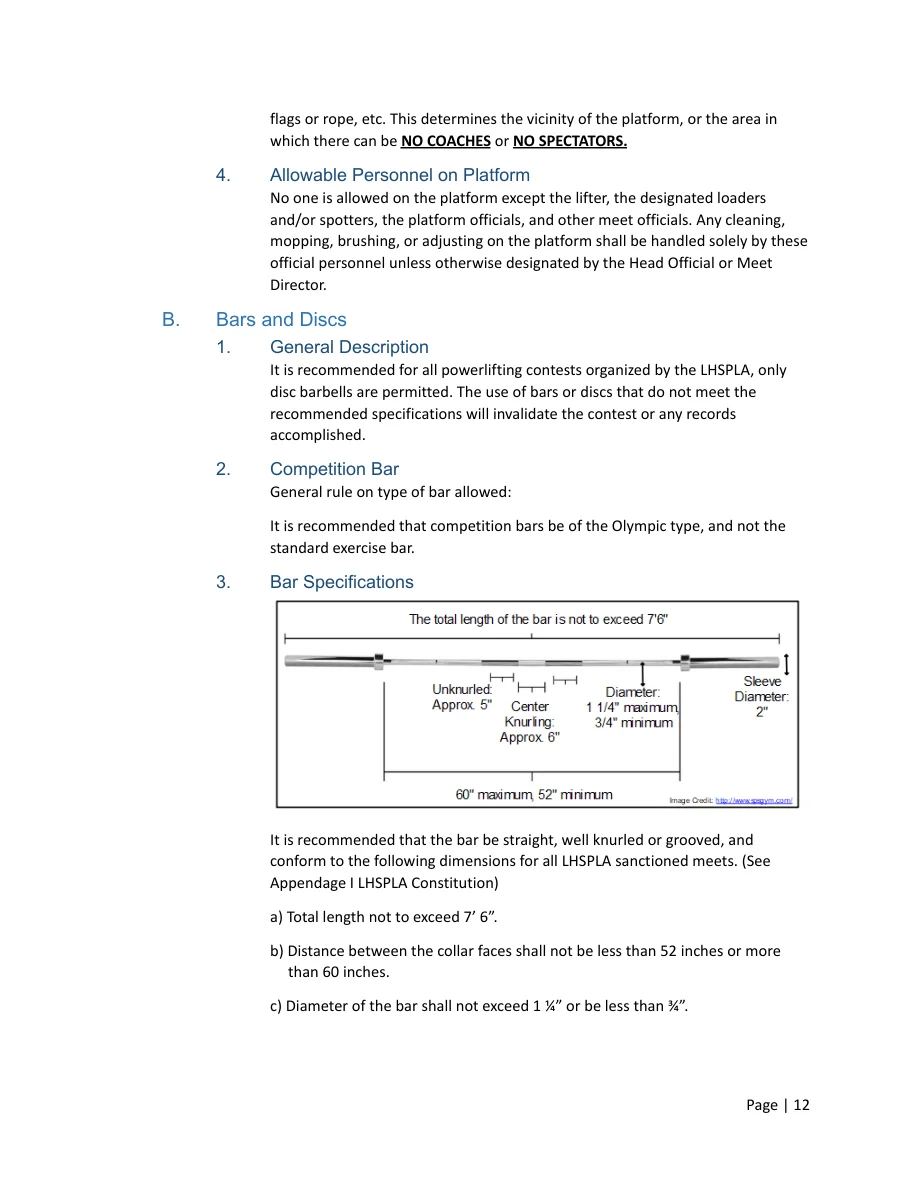
d) When using collars, the weight of the bar and collars shall be 55 pounds, and when using speed collars, the weight of the bar and collars shall be 45 pounds.
e) Diameter of the sleeve shall be 2”.
f) Center knurling on the bar should be approximately 6” wide with approximately 5” of unknurled bar on either side. Knurling should be 12-14 lines per inch, pointed (not flattened), and free from all paint, chrome, nickel, or other materials.
4. Plate Specifications
a) It is recommended that all plates on lifting platforms should be of the same make and manufacturer, especially at the LHSPLA State Championship Meet. Ex. All York plates, Standard.
b) Plates shall include the following weight sizes: 2 ½ pound, 5 pound, 10 pound, 25 pound, 45 pound, and 100 pound.
c) Each plate shall have its weight clearly marked and shall be loaded in the following sequence: Heaviest plate innermost with the lighter plates in descending order.
d) The first and heaviest plate shall be loaded on the bar facing in, with the rest of the plates loaded facing out in descending order.
5. Collars: Use and Specifications
a) Collars or speed collars are required to be in place during all competition lifts and tightened away from the discs, if requested by the lifter.
b) It is recommended that the collars weigh 5 pounds each when used, or 0 pounds of negligible weight when using speed collars with the standard power bar.
c) Collars or speed collars are required to be in place during all competition lifts except when the minimum of 45 lbs. is being attempted by a lifter during a meet.
C. Squat Racks
1. Construction and Stability
It is recommended that the squat racks shall be of a sturdy construction and provide maximum stability. The base shall be of such design that it does not impede the lifter or the spotter-loaders.
2. Height of Racks (Maximum and Minimum)
It is recommended that squat racks shall be designed to adjust from a minimum height of 39 inches in the lowest position, to a maximum of 66 inches in the highest position.
View page layout · 13
3. Height Adjustment
It is recommended that height adjustment shall be at increments not to exceed 2 inches.
4. Securing of Racks by Pins
It is recommended that hydraulic racks shall be capable of being secured at the required height by means of pins.
5. Rack Width Settings
Referring to rack width setting, OUT means the racks are near the collars of the bar and IN means the racks are near the 32-inch bar markings.
6. Squat Racks in Warm-Up Room
It is recommended that approved types of squat racks or power racks also be used in the warm-up room.
D. Bench Press
1. Dimensions
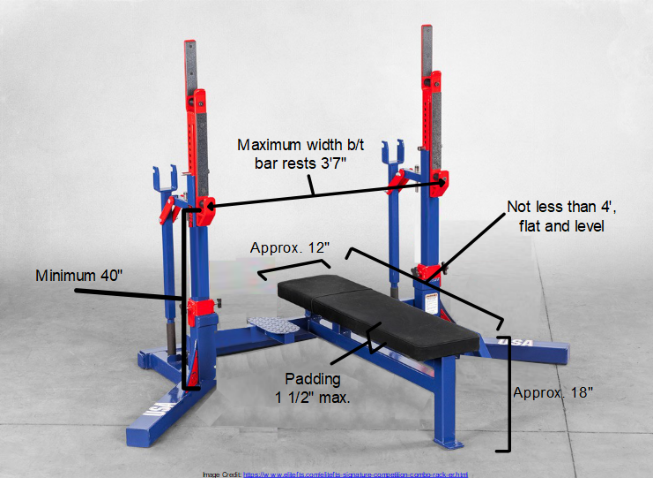
It is recommended that the bench be of sturdy construction for maximum stability and recommended it conforms to the following dimensions:
a) Length: Not less than 4 feet, flat and level.
b) Width: Approximately 12 inches.
c) Height: Approximately 18 inches measured from the floor to the top of the surface of the bench without being depressed or compacted. The height of
View page layout · 14
the uprights on adjustable and non-adjustable benches shall be a minimum of 40 inches measured from the floor to the bar rest position.
d) Maximum width between the inside of the bar rests shall be 3 feet 7 inches.
2. Recommended Bench for Warm-Up Room
It is recommended that the approved type bench also be used in the warm-up room.
E. Lights
1. Providing of Lights
A system of lights shall be provided whereby the officials can make known their decisions.
2. Officials’ Control of Lights
Each official will control a white and a red light representing a good lift or no lift, respectively.
3. Arrangement of Lights
The lights can be arranged horizontally or vertically as long as they are in sight of the expeditors and the officials working at the scoring table.
4. Controlling of Master Switch
If the wires are set up to light up together, the Head Official on the platform shall be in charge of the master switch.
5. When Lights Are Not Wired to Light Up Simultaneously
If the lights are not wired to light up simultaneously, each official should make his/her decision and turn the light on when the bar makes contact with the rack (when being replaced) in the squat and the bench press, and when the bar makes contact with the platform (after completion of the lifters attempt) in the deadlift. For uniformity, the lights should be turned off at the same time when the lifter leaves the platform.
6. Electrical Breakdown
For emergency purposes (electrical breakdown), the officials will be provided with small white (good lift) and red (bad lift) flags to indicate their decisions, or if they do not have flags they will give a visual “thumbs up” for a good lift or “thumbs down” if the official decides that a lift is not successful.
View page layout · 15
III. Costume and Personal Equipment
A. Approved Supportive Equipment
The list of approved supportive equipment listed below will be used as a guide in determining whether the supportive equipment utilized by a lifter is legal or not. This guide shall also be posted on the LHSPLA website.
**This list will be updated annually based on the addition of new equipment by different manufacturers.
Any successful State record lift will be followed by a cursory examination of the supportive equipment utilized in that lift to determine whether the supportive equipment utilized by the lifter is legal. If the supportive equipment is found to be illegal; the lifter will not get credit for the successful record lift, but in no case shall any previous lift be taken away unless the infraction was noticed, the coach was informed of the infraction, and the infraction went uncorrected.
| Inzer | Titan | Metal | Ken Anderson |
| Z-Suit | Squat Suits | Metal Squatter | KLA 2000 Gold Knee Wraps 2.0 M |
| Champion Suit | Centurion Suits | Metal Viking Squatter | KLA 2000 Knee Wraps 2.0 M |
| Hard Core Suit | Red Devil Wraps | Metal Squatter v-type | THP Knee Wraps 2.0 M |
| TRX Squat Suit | Signature Gold wraps | Metal Viking Squatter v-type | Max RPM Knee Wraps 2.0 M |
| Megathrust Squat Suit | Titanium wraps | Metal King Squatter | Titanium Knee Wraps 2.0 M |
| MAX DL Deadlift Suit | Velocity Deadlift Suit | Metal King Squatter V-type | Signature Gold Knee Wraps 2.0 M |
| Fusion Deadlift Suit | Titan Fury Shirts | Metal Bencher | KLA 2000 Gold Wrist Wraps 18” |
| XDL Deadlift Suit | Knee Wraps THP (with lettering or yellow stripe) | Metal Viking Bencher | THP Wrist Wraps 12” |
| Iron Wraps A and Z | Knee Wraps Max RPM (Black with green, pink or orange stripes) | Metal Viking Bencher X Type | THP Wrist Wraps 18” |
| Erector Shirt | Wrist Wraps THP (with lettering or yellow stripe) | Metal Viking Presser | KLA 2000 – 24” Lime Wrist Wraps |
| Sleeveless Erector Shirt | Wrist Wraps Max RPM (Black with green, pink or orange stripes) | Metal Presser | Max RPM Wrist Wraps 24” |
| Heavy Duty Erector Shirt | F6 Tornado Shirt | Metal Deadlifter | Max RPM Wrist Wraps 36” |
| Sleeveless Heavy Duty Erector Shirt | Fury NXG Plus SHP Bench Shirt | Metal Viking Deadlifter | Signature Gold Wrist Wraps 12” |
| Blast Shirt | Katana Shirts | Metal King Sumo Deadlifter | KLA 2000 Lime Wrist Wraps 36” |
| Heavy Duty Blast Shirt (HD) | Super Katana | Metal King Deadlifter | KLA 2000 Gold Wrist Wraps 24” |
| High Performance Heavy Duty Blast Shirt (HPHD) | Super Katana low cut | Metal Blackline Wraps | KLA 2000 wrist wraps 18” |
| Extra High Performance Heavy Duty Blast Shirt (EHPHD) | Super Centurion | Metal Black Wraps | KLA 1000 Wrist Wraps 24” |
| Phenom Shirt | Spartan Suits | Metal Triple Blackline Wraps | Titanium Wrist Wraps 24” |
| The Wrath bench shirt | Titan Knee Sleeves | Mystical Wraps | KLA 3000 Wrist Wraps 24” |
| The Rage bench shirt | Titan Knee Sleeves – Yellow Jacket | Silver and Orange Wraps | KLA 4000 Double Super Heavy Plus Wrist Wraps 24” |
| Rage-X bench shirt | Titan Singlet | King Bencher | Titanium Wrist Wraps 36” |
| XB bench Shirt | ELEIKO | King Presser | KLA 4000 Double Super Heavy Plus Wrist Wraps 36” |
| BOLT Bench shirt | ELEIKO Knee Sleeves | King bencher x-type | KLA 1000 Wrist Wraps 18” |
| Wrist True Black Wrap | REHBAND | Metal Knee Sleeves | Max RPM Wrist Wraps 12” |
| Knees True Black Wrap | Rehband Knee Sleeves | Metal Singlets | Max RPM Wrist Wraps 18” |
| W30 Wraps | SBD | Strengthshop | THP Wrist Wraps 24” |
| W40 Wraps | SBD Knee Sleeves | Strengthshop Knee Sleeves | KLA 3000 Lime Wrist Wraps 24” |
| W50 Wraps | SBD Singlets | Strengthshop Singlets | KLA 2000 Wrist Wraps 36” |
| W60 Wraps | SBD Wrist Wraps | Signature Gold Wrist Wraps 18” |
View page layout · 16
| W70 Wraps | Bukiya.net | Signature Gold Wrist Wraps 24” | |
| W80 Wraps | Oni Sleeves (Knee Sleeves) | Titanium Wrist Wraps 12” | |
| INZER Singlets | Titanium Wrist Wraps 18” | ||
| KLA 2000 Wrist Wraps 24” | |||
| KLA 2000 Gold Wrist Wraps 36” | |||
| THP Wrist Wraps 36” | |||
| KLA 2000 – 36” Lime Wrist Wraps | |||
| KLA 3000 Wrist Wraps 36” | |||
| Signature Gold Wrist Wraps 30” |
B. Costume (Lifting Suit)
1. General Rule
A lifting suit shall be worn consisting of a one-piece full-length lifting suit of one-ply stretch material without any additional patches or padding. The straps shall be worn over the shoulders at all times while the lifter is on the platform. The lifting suit may not be made of any materials such as spandex. A t-shirt with a hemmed sleeve that does not extend below the elbow must be worn under the lifting suit or singlet when on the platform and during the execution of a lift.
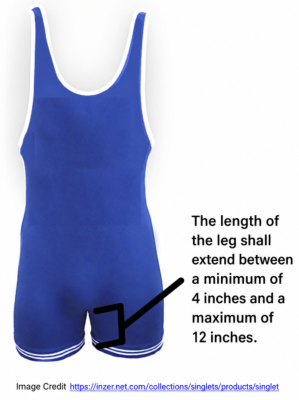
If a lifter chooses to compete in a lifting singlet it is recommended that it must meet the requirements listed in Section III.B.2.a-e. No singlet shall be worn that gives a lifter an unfair or competitive advantage over other lifters. All lifters must wear a minimum of a singlet during all lifts at all LHSPLA sanctioned meets.
2. Specific Rule
a) The crotch panel shall be of one-ply for suits used in the squat and the deadlift.
b) A folded strap or a strap that has a piece of material added is legal on a suit as long as it does not increase the total thickness of the suit. Any suit that has been torn and has been subsequently repaired with an acceptable one-ply
View page layout · 17
material should be legal as long as it does not increase the total thickness of the suit. A team may alter a suit within the specified guidelines and use “bunny ears” that show on the outside or inside of the suit. “Bunny ears” must be stitched. The LHSPLA shall be the final arbiter as to whether the supportive equipment is legal or not.
c) There shall be no obscene or profane markings on lifting attire worn on the platform or at the meet site.
d) The length of the leg shall not exceed 6 inches from the middle of the crotch to the edge of the leg length extend between a minimum of four (4) inches and a maximum of twelve (12) inches. This measurement should be taken when the suit is lying unworn on a table.
e) Any alterations to a suit, which exceed the established widths, lengths, or thickness previously mentioned, shall make a suit illegal for competition. The LHSPLA shall be the final arbiter as to whether the supportive equipment is legal or not.
C. Shirt
1. General Rule
Any type of t-shirt, jersey, or other type of shirt with a hemmed sleeve must be worn; all shirts shall be worn under the lifting suit or singlet. The shirt sleeve must remain above the elbow. The shirt shall be made of one-ply cotton, polyester, or a combination of the two.
Bench shirts may be worn if they fit according to the general rule above. The material must cover the whole of the deltoid area. No shirts with cut off sleeves will be allowed.
2. Specific Rule
It shall not be ribbed or consist of any rubberized materials, denim, or similar stretch materials.
D. Socks
1. Allowable Socks
Socks of any type or color, with any type of logo, emblem, etc. may be worn as long as no obscene or profane markings are present. It is permissible for lifters to wear more than one pair of socks.
2. Length of Socks
They shall not be so long that they touch any knee wrappings or one-piece knee cap supporter when in use.
3. Full Length Stockings
Full length stockings, tights or hose are strictly forbidden.
View page layout · 18
4. Shin Length Socks
Shin length socks must be worn to cover and protect the shins while performing the deadlift. The socks cannot extend higher than the crease in the knee joint at the back of the knee.
E. Religious Exemption on Costume
1. Squat - long sleeve cotton T-shirt under squat suit, non-supportive material covering exposed skin, knee wraps, socks.
2. Bench - non supportive arm sleeve to sleeve of bench shirt, singlet, non-supportive leg covering.
3. Deadlift – long sleeve cotton T-shirt under her suit or singlet, non-supportive leg covering.
Religious exemptions for personal apparel/equipment requirements may be granted at the discretion of the Executive Committee. Any request for an exemption must be made by the coach via the appropriate application form found on the Forms page of the LHSPLA website at least 21 days prior to the lifter’s first intended competition of the season.
● Submission of an exemption request does not guarantee that it will be granted. ● The coach will receive a detailed letter clearly listing specific exemptions granted for individual lifters.
F. Athletic Supporter/Briefs
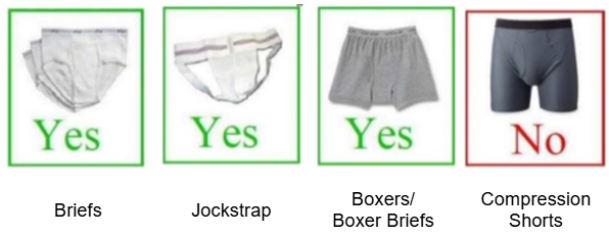
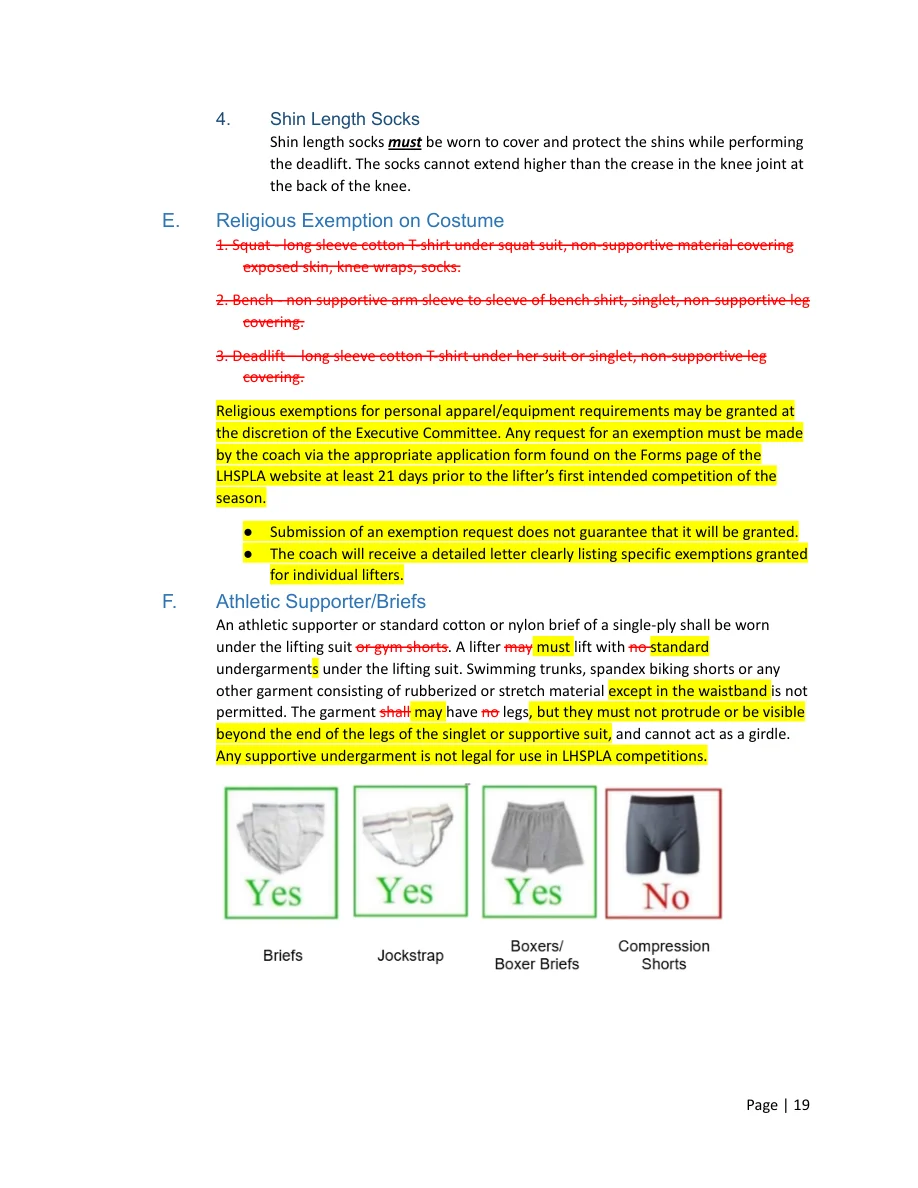
An athletic supporter or standard cotton or nylon brief of a single-ply shall be worn under the lifting suit or gym shorts. A lifter may must lift with no standard undergarments under the lifting suit. Swimming trunks, spandex biking shorts or any other garment consisting of rubberized or stretch material except in the waistband is not permitted. The garment shall may have no legs, but they must not protrude or be visible beyond the end of the legs of the singlet or supportive suit, and cannot act as a girdle. Any supportive undergarment is not legal for use in LHSPLA competitions.
View page layout · 19
G. Women’s Wear Beneath the Lifting Suit
1. Undergarments
Women shall wear protective briefs or panties as long as they are not deemed supportive in any way. Women may also wear a bra as long as it does not retain its shape when placed in an upright or flat position. Only one bra (layer of clothing) can be worn beneath a lifters’ t-shirt or bench shirt. Hose or panty hose are not permitted.
H. Belt
1. Wearing a Belt
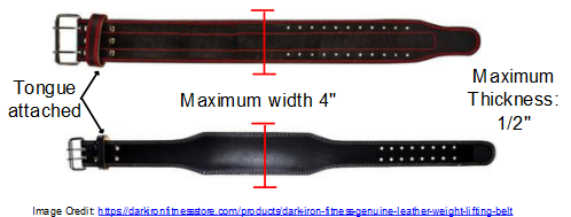
A competitor may wear a belt. If worn, it shall be on the outside of the lifting suit.
2. Materials and Construction
a) The main body of the belt shall be made of leather or vinyl in one or more laminations, which may be glued and/or stitched together.
b) It shall not have any additional padding, bracing, or supports of any material.
c) Any type of buckle or fastener is permitted provided the underloop of the two ends of the belt does not exceed 4 inches.
d) A tongue shall be attached close to the buckle.
e) One or two prong buckles may be used.
3. Dimensions
a) Maximum belt width – 4 inches.
b) Maximum belt thickness – ½ inch.
View page layout · 20
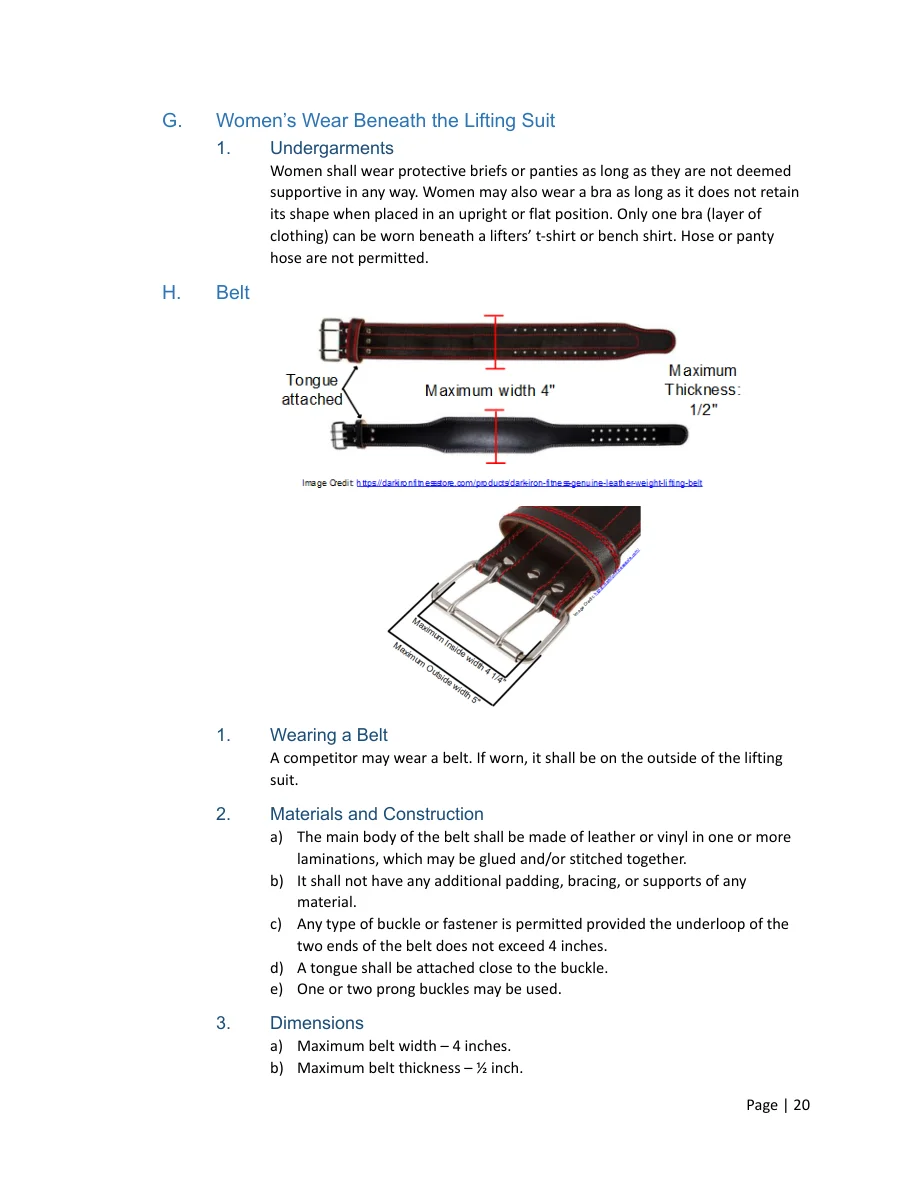
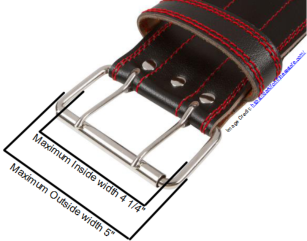
c) Maximum inside buckle width – 4 ¼ inches.
d) Maximum outside buckle width – 5 inches.
I. Foot Attire on The Platform
1. General Rule
Any type of un-cleated or unspiked shoe or boots with a sole shall be worn. Shoes shall be closed toe with a closed heel.
2. Definition of Soles
Shoe shall include boots, sport shoes, cross trainers or any foot covering that has a patterned molded sole.
3. Exclusions
The following: sandals, flip flops, crocs, and/or any other types of backless footwear is not permissible.
J. Wraps
1. General Rule
Wraps may be worn, however, only wraps or bandages of medical crepe or one-ply commercially woven elastic that is covered with polyester, cotton or a combination of both materials is permitted. Bandages of rubber or rubberized substitutes are strictly forbidden. Virtually any type of fastening device is illegal except adhesive tape.
The commercial manufacturers listed in Section III.A of the LHSPLA Rulebook will be used as a guide for use in all LHSPLA Sanctioned Meets.
2. Legal Use of Wraps
a) Wrists – Wraps shall not exceed 3’ 3” in length and 3” in width. A combination of two or more wrist wraps is forbidden.
(1) If wristbands are the wrap around style, the Velcro fastener cannot be so long that it completely encircles the wrist. Also, if it has a thumb loop fastener, it cannot be secured around the thumb during the execution of the actual lift. No part of the wrap can be between the hand and the bar. Incidental contact between the loop and the bar is not cause for disqualification of the lift.
(2) A wrist wrap shall not extend beyond 4 inches above the center of the wrist joint and ¾ inch below the center of the wrist joint. The total wrap cannot exceed 5 inches in length.
b) Knees – Wrap shall not exceed 6’ 6” in length. A knee wrap shall not extend over 6 inches above or below the center of the knee joint. The total wrap cannot exceed 12 inches.
View page layout · 21
3. Illegal Use of Wraps
a) Wraps shall not touch the socks or the lifter’s suit.
b) Wraps shall not be used elsewhere on the body other than the knees and the wrist.
K. Knee Sleeves
Sleeves, being cylinders of neoprene, may be worn only on the knees by the lifter in the performance of any lift in competition; sleeves cannot be worn or used on any part of the body other than the knees. Knee sleeves cannot be worn where the lifter also wears knee wraps, as per the rule “Wraps” below.
Knee sleeves must conform to the following specifications:
1. Knee Sleeve Construction
The sleeves must be constructed entirely of a single-ply of neoprene, or predominately of a single-ply of neoprene plus a non-supportive single layer of fabric over the neoprene. There may be stitched seams of the fabric and/or of the fabric onto the neoprene. The entire construction of the sleeves may not be such as to provide any appreciable support or rebound to the lifter’s knees;
2. Knee Sleeve Dimensions
Knee sleeves shall be a maximum thickness of 7 mm and a maximum length of 30 cm.
3. No Additional Strapping
Knee sleeves shall not have any additional strapping, Velcro, drawstrings, padding or similar supportive devices in or on them. Knee sleeves must be continuous cylinders, without holes in the neoprene or in any covering material;
4. No Contact When Worn
When worn by the lifter in competition, knee sleeves must not be in contact with the lifter’s suit or socks and must be centered over the knee joint.
Lifters may not have or use any form of assistance (from another person, or suit slippers, plastic bags, powder, etc.) to put on knee sleeves. Officials may ask lifters to demonstrate they can put on their sleeves without assistance. Athletes are permitted to receive personal assistance in the application of their knee sleeves.
L. Equipment Waiver Enforcement at Meets
1. Coaches Inspection of Team Equipment
Coaches will be required to inspect his/her team’s own equipment (lifting suits, belts, and wraps). They will be required to sign a waiver verifying that all equipment that is being used by his/her team complies with Section III of this rulebook.
View page layout · 22
2. Consequences for Major and Minor Equipment/Attire
If a lifter steps on the platform and is found to be wearing an illegal article of attire, or illegal piece of equipment, whether intentional or not, he/she shall accept the consequences of violating LHSPLA rules on platform attire and equipment. The penalty is a warning for a minor infraction, and disqualification of a lift for a major infraction.
3. Repeated Use of Invalid Equipment (Major/Minor)
If a lifter performs a lift in an invalid piece of equipment or attire, the lifter shall be warned and the lift allowed (for minor infractions) on their first attempt. Repeated use of equipment and attire with minor infractions will result in any subsequent lifts being disqualified. Repeated use of illegal attire and equipment by the lifter shall be cause for disqualification. A lifter, who is found guilty of a major equipment or attire infraction (intentional or unintentional) and uses the same illegal equipment or attire again, shall be disqualified. In no case shall a lift be allowed when a major infraction occurs.
View page layout · 23
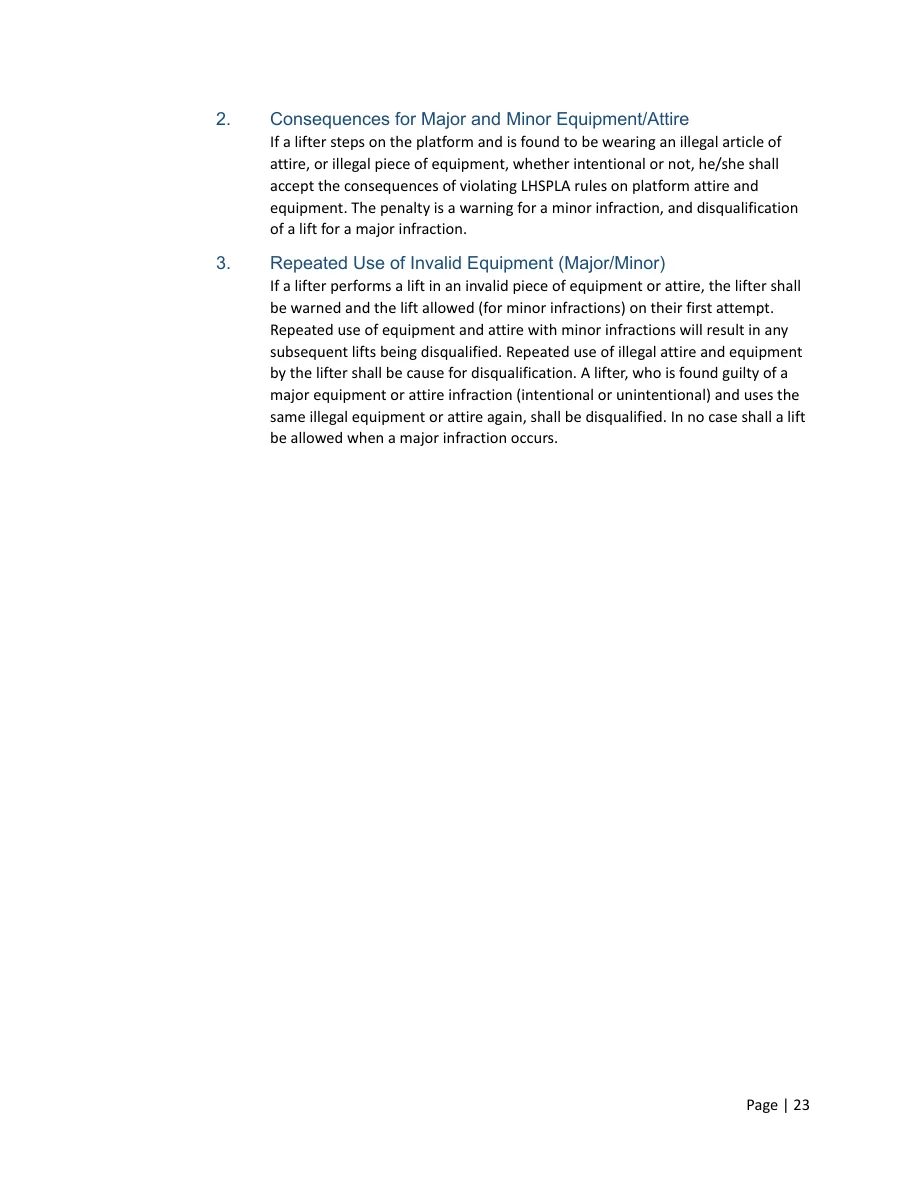
LHSPLA EQUIPMENT WAIVER
Updated for 2024-2025
I, the undersigned, do hereby verify that I have inspected my team’s lifting equipment, which includes their lifting suits, belts, bench shirts, wraps (Knee and Wrist), and knee sleeves and have found them in compliance with the rules and regulations stated in Section III of the Technical Rules of the Louisiana High School Powerlifting Association. I also understand, that if one of my team members steps on the platform at an LHSPLA Regional or State Meet, and is found to be wearing an illegal article of attire or illegal piece of equipment, whether intentional or not, he/she shall accept the consequences of violating the LHSPLA rules on platform attire and equipment (See Section III.K.2-3).
____________________________________________________ Coach or School Representative
____________________________________________________ School
____________________________________________________ Competition (LHSPLA Regional or State)
____________________________________________________ Date
View page layout · 24
M. Major Rule Infractions: Costume and Equipment
These infractions result in the disqualification of a lift:
1. Wraps more than 1 foot over length.
2. Wearing two sets of wraps.
3. Use of two suits, two bench shirts, girdles, braces, reinforced double-ply suits, or highly supportive underwear.
4. Use of oil, grease, jelly, lotion or other lubricant on legs.
5. Additional bracing or covering in or on the belt.
6. Use of elbow wraps.
7. Wearing obscene or profane apparel on the platform.
8. Wearing dirty or torn items on the platforms that are deemed to be an embarrassment to the sport.
9. Wearing items that have been rejected at that competition.
10. Wearing attire with illegal alterations.
11. Wearing a belt that is so long it is wrapped around the lifter and gives the effect of a double belt.
12. Any use of adhesive tape not approved by the Head Official or Meet Director.
13. Use of illegal substances on the lifter and/or the lifter’s attire.
14. Illegal use of plasters (Band-Aids, bandages, etc.) that aid the lifter.
15. Wearing a football girdle, biker or compression shorts underneath the lifting suit.
N. Minor Infractions: Costume and Equipment
These infractions result in a warning on the first attempt and disqualification of the lift on subsequent attempts:
1. Wraps touching the socks.
2. Wraps a few inches too long.
3. Wearing a Belt that is over 4 inches wide.
4. Wearing more than one t-shirt.
5. Improperly attached wraps.
6. Straps on lifting suit not over the shoulders while lifting.
7. Knee wraps that extend more than 6 inches above or below the knee joint.
8. Using wraps with Velcro straps that gives joint support.
9. Using the thumb loop of a wrist wrap during the lift.
View page layout · 25
10. Wearing a shirt with sleeves past the elbow.
11. Wearing a shirt or t-shirt without a hem on the sleeve.
12. Wearing cleats.
13. Lifting in leotards.
O. Prohibited and Acceptable Items/Accessories
Soft pliable hair control devices and mouthpieces are acceptable on the platform. Use of hair control devices made of metal or hard plastic are acceptable on the platform. Hats are strictly forbidden and may not be worn on the platform during the execution of lift. Items such as watches, jewelry (lip rings) and sunglasses are also unacceptable on the platform. Prescription eyewear (glasses) is acceptable on the platform. Jewelry that is acceptable on the platform (ear rings, nose rings, bracelets and necklaces).
| Acceptable Items/Accessories | Prohibited Items/Accessories |
| ● Any type of hair control device (such as hair elastics and barrettes) or standard commercial headband not exceeding 4 inches in width ● Prescription eyewear ● Jewelry (such as small earrings, small facial piercings, small bracelets, and small necklaces/chains) ● Mouthpieces that remain inside the lifter’s mouth | ● Hats and head coverings of any type ● Watches ● Sunglasses ● Headphones, earbuds, etc. ● Any jewelry that is excessively large or heavy ● Any jewelry that comes between the lifter’s hand and the bar ● Mouthpieces that extend outside the lifter’s mouth |
| The LHSPLA shall be the final arbiter as to whether items/accessories are acceptable to be worn on the lifting platform. |
P. Use of Substances on The Lifter or On the Lifter’s Attire/Equipment
1. Forbidden Substances
The use of water, oil, grease, baby powder, or other lubricants on the body, costume or personal equipment is strictly forbidden.
2. Allowable & Prohibited Substances
Pool hall chalk, and magnesium carbonate, and liquid chalk are permitted are the only two substances that may be added to the body and attire, provided it has no adhesive substances/properties. Applying any substance by use of a shaker bottle is prohibited regardless of form. Pool chalk must be in a conical form, and Magnesium carbonate can be square block or ball, and the liquid chalk should only consist of magnesium carbonate and alcohol. No Foreign
View page layout · 26
substances, including but not limited to stick-um and touch is are strictly prohibited. They may not be applied to the skin, soles of shoes, or wraps.
View page layout · 27

IV. The Powerlifts and Rules of Performance
Let it be known that all LHSPLA Officials interpretations of the Rules of Performance for the Squat, Bench and Deadlift, are always done with the safety and welfare of the lifters, spotters/loaders and officials in mind.
A. Squat
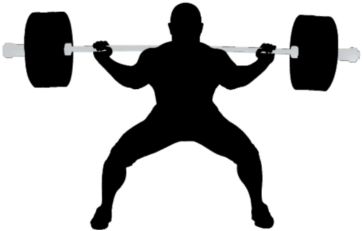
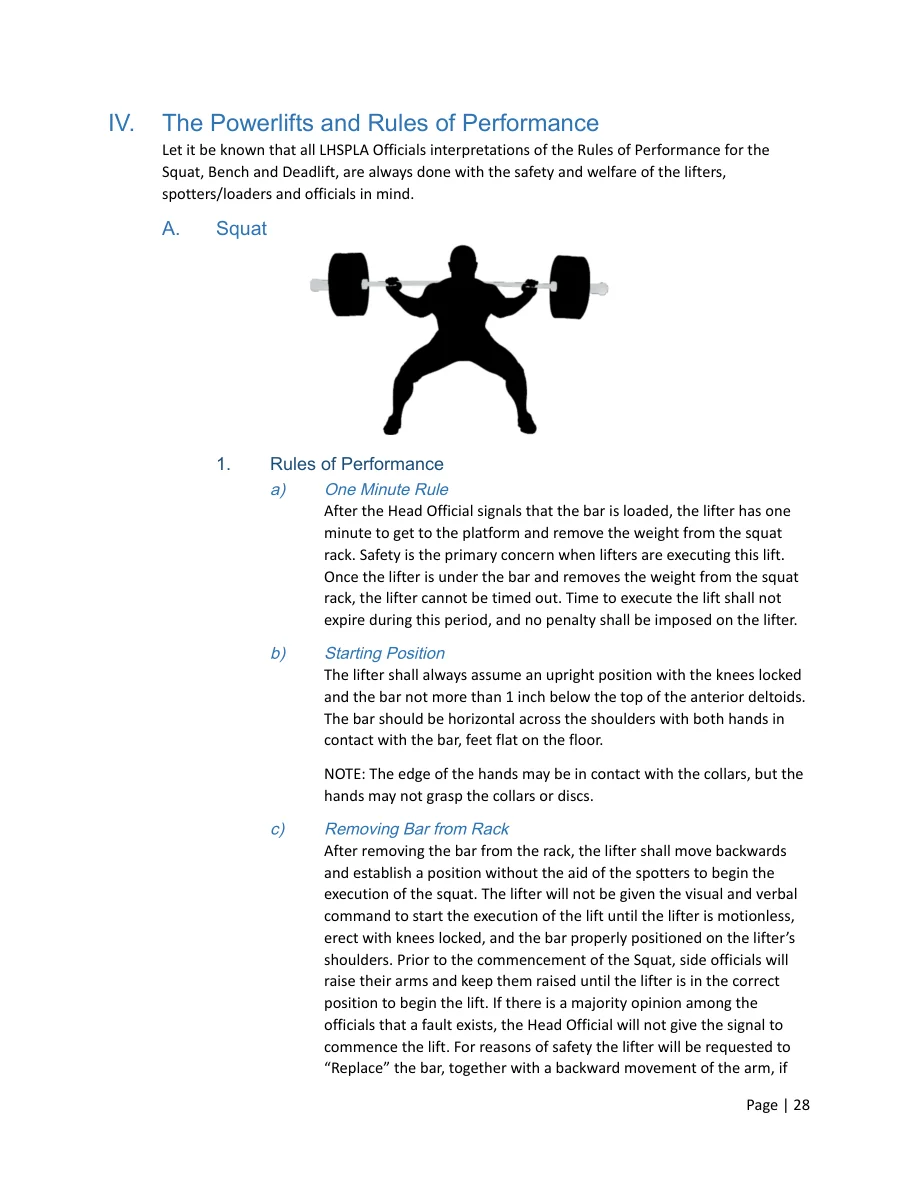
1. Rules of Performance
a)
One Minute Rule After the Head Official signals that the bar is loaded, the lifter has one minute to get to the platform and remove the weight from the squat rack. Safety is the primary concern when lifters are executing this lift. Once the lifter is under the bar and removes the weight from the squat rack, the lifter cannot be timed out. Time to execute the lift shall not expire during this period, and no penalty shall be imposed on the lifter.
b)
Starting Position The lifter shall always assume an upright position with the knees locked and the bar not more than 1 inch below the top of the anterior deltoids. The bar should be horizontal across the shoulders with both hands in contact with the bar, feet flat on the floor.
NOTE: The edge of the hands may be in contact with the collars, but the hands may not grasp the collars or discs.
c)
Removing Bar from Rack After removing the bar from the rack, the lifter shall move backwards and establish a position without the aid of the spotters to begin the execution of the squat. The lifter will not be given the visual and verbal command to start the execution of the lift until the lifter is motionless, erect with knees locked, and the bar properly positioned on the lifter’s shoulders. Prior to the commencement of the Squat, side officials will raise their arms and keep them raised until the lifter is in the correct position to begin the lift. If there is a majority opinion among the officials that a fault exists, the Head Official will not give the signal to commence the lift. For reasons of safety the lifter will be requested to “Replace” the bar, together with a backward movement of the arm, if
View page layout · 28
after a period of five seconds he/she is not in the correct position to begin the lift. The Head Official will then convey the reason why the signal was not given. The lifter then has the ONE opportunity to correct the position of the bar or his stance in order to receive the commencement signal. Once a lift has commenced, the side officials will not call attention to faults during the execution of the lift.
NOTE: Spotter/loaders may assist the lifter with removing the bar from the rack.
d)
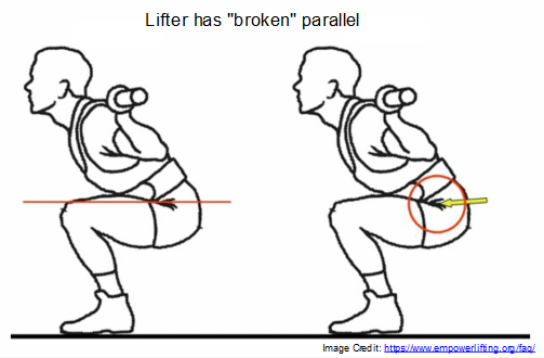
Execution of the Squat The head official will give the command of “SQUAT” to the lifter. Upon receiving the command to start the execution of the squat, the lifter shall bend the knees and lower the body until the lifter has broken parallel where the hip joint has descended below the top of the knee joint. The knees must be locked at the start and the completion of the lift.
NOTE: If the knees cannot be anatomically fully extended, the lifter should inform the official before the lift.
e)
Recovery Phase of Lift The lifter will recover at will from the bottom position of the squat without double bouncing or letting the bar descend after the initial movement upward. The bar may stop on the way up from the bottom position of the lift, but it may not descend once the upward motion has begun.
f)
Bona Fide Attempt to Return the Bar to the Rack The signal to replace the bar shall consist of a backward motion of the official’s hand and the verbal command “rack”. The lifter must return the
View page layout · 29
bar to the rack. Foot movement after the rack signal will not be cause for failure. The lifter must stay with the bar during this process.
NOTE: Spotters/loaders may aid the lifter in returning the bar and replacing it in the rack after the “rack” command is given.
g)
Number of Spotters/Loaders on Platform Not more than 5 and not fewer than 3 spotters/loaders shall be on the platform at any time. Designated meet spotters may be replaced or augmented at the discretion of the Head Official-In-Charge or the approval of the Meet Director.
h)
Allowable Spotter/Loader Assistance The lifter may ask the spotters/loaders to help him remove the bar from the rack. After that the spotters/loaders may not assist the lifter in any other way in reference to bar position, foot position, etc.
i)
Spotter Error, Equipment Failure, Disarrangement of Platform A lifter may be given another attempt with the same weight if a lift or attempt was missed due to an error made by a spotter/loader, failure of platform equipment, or disarrangement of the platform. If this situation occurs in the middle of a round, the lifter will be given another attempt at the end of the round. If this occurs at the end of a round see Section V.J.6.
j)
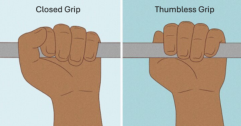
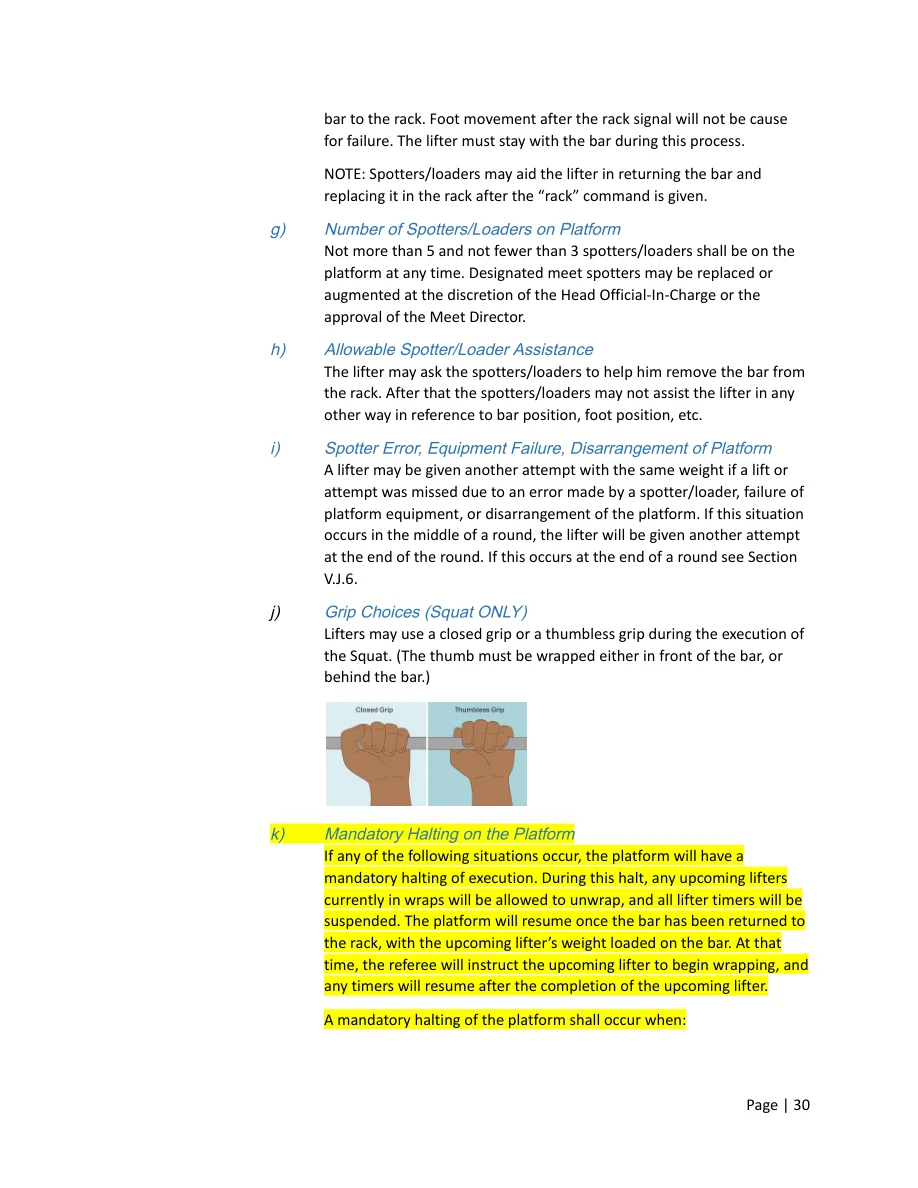
Grip Choices (Squat ONLY) Lifters may use a closed grip or a thumbless grip during the execution of the Squat. (The thumb must be wrapped either in front of the bar, or behind the bar.)
k)
Mandatory Halting on the Platform If any of the following situations occur, the platform will have a mandatory halting of execution. During this halt, any upcoming lifters currently in wraps will be allowed to unwrap, and all lifter timers will be suspended. The platform will resume once the bar has been returned to the rack, with the upcoming lifter’s weight loaded on the bar. At that time, the referee will instruct the upcoming lifter to begin wrapping, and any timers will resume after the completion of the upcoming lifter.
A mandatory halting of the platform shall occur when:
View page layout · 30
i) during the execution of the current squat attempt, the bar hits the floor
ii) a medical emergency or injury resulting in the meet’s medical personnel having to tend to the lifter on the platform
2. Cause for Disqualification
a) Failure to wait for the command to start.
b) Double bouncing, or more than one recovery attempt at the bottom of the lift.
c) Failure to assume an upright position (knees locked) at the beginning or end of the lift.
d) Any lateral movement of the feet. Rocking back and forth on the feet between the ball and heel of the foot is permitted though.
e) Failure to break parallel on the squat attempt.
f) Change the position of the bar on the shoulders after starting the lift, intentional or unintentional.
g) Contact of elbows or upper arms with the legs.
h) Failure to make a bona fide attempt to return the bar to the rack. i)
Any dropping or dumping of the bar that is determined intentional. j)
Failure to remove the bar from the rack within the one minute period after the “bar is loaded” command is given by the Head Official on the platform.
NOTE: Stopping of the bar during the ascent portion of the squat is not cause for disqualification of the lift. This also applies in the Bench Press and the Deadlift.
NOTE: Intentional dropping or dumping of the bar may result in the lifter being disqualified from the meet. There must be unanimous agreement amongst the platform officials that a bar was “dumped” before a lifter is disqualified from a meet.
NOTE: While movement of the hands during the performance of the squat is not a cause for disqualification of the lift, the hands, thumb, and fingers MUST remain in complete contact with the bar for the duration of the lift.
View page layout · 31
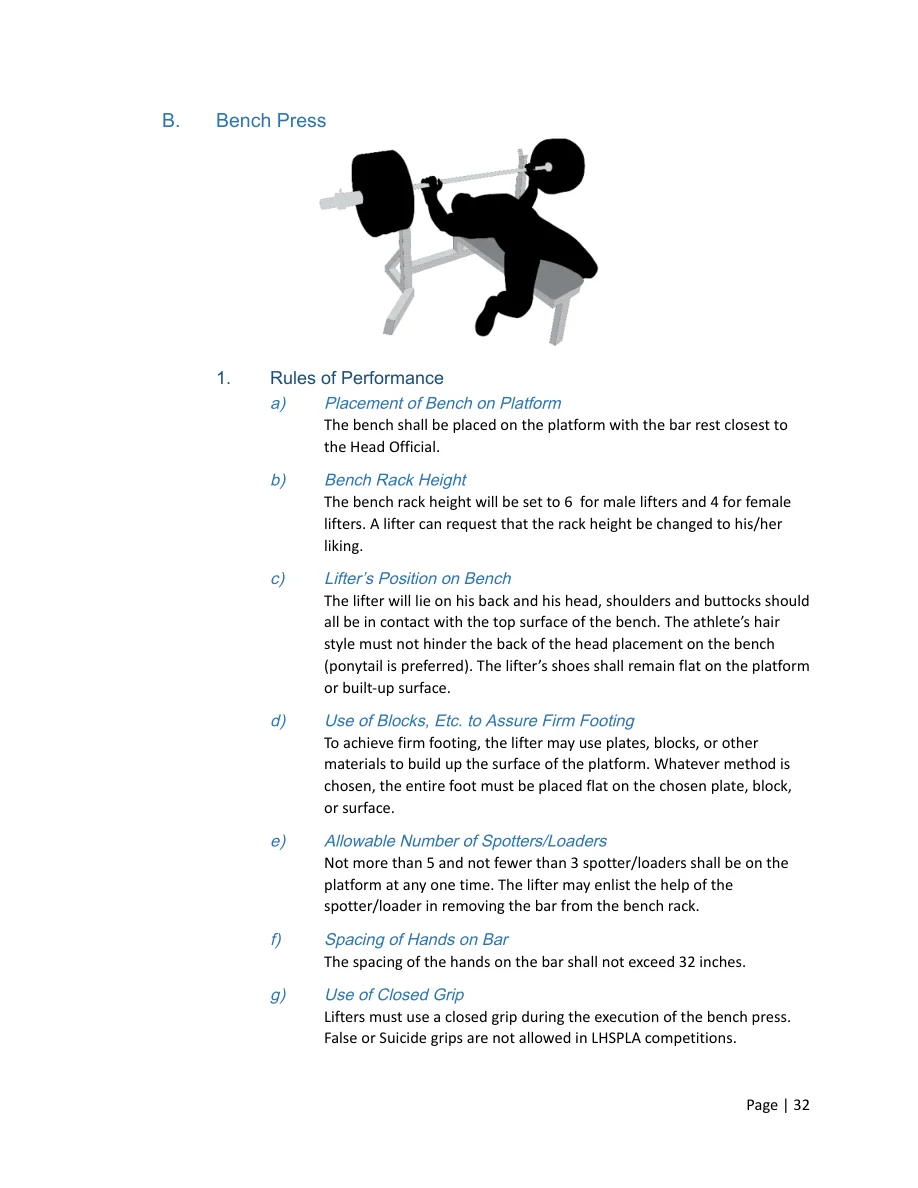
B. Bench Press
1. Rules of Performance
a)
Placement of Bench on Platform The bench shall be placed on the platform with the bar rest closest to the Head Official.
b)
Bench Rack Height The bench rack height will be set to 6 for male lifters and 4 for female lifters. A lifter can request that the rack height be changed to his/her liking.
c)
Lifter’s Position on Bench The lifter will lie on his back and his head, shoulders and buttocks should all be in contact with the top surface of the bench. The athlete’s hair style must not hinder the back of the head placement on the bench (ponytail is preferred). The lifter’s shoes shall remain flat on the platform or built-up surface.
d)
Use of Blocks, Etc. to Assure Firm Footing To achieve firm footing, the lifter may use plates, blocks, or other materials to build up the surface of the platform. Whatever method is chosen, the entire foot must be placed flat on the chosen plate, block, or surface.
e)
Allowable Number of Spotters/Loaders Not more than 5 and not fewer than 3 spotter/loaders shall be on the platform at any one time. The lifter may enlist the help of the spotter/loader in removing the bar from the bench rack.
f)
Spacing of Hands on Bar The spacing of the hands on the bar shall not exceed 32 inches.
g)
Use of Closed Grip Lifters must use a closed grip during the execution of the bench press. False or Suicide grips are not allowed in LHSPLA competitions.
View page layout · 32
h)
One Minute Rule After the Head Official signals that the bar is loaded, the lifter has one minute to get to the platform and remove the weight from the rack. Safety is the primary concern when lifters are executing this lift. Once the lifter removes the weight from the rack, the lifter cannot be timed out. Time to execute the lift shall not expire during this period, and no penalty shall be imposed on the lifter.
i)
Starting Position of Lift After removing the bar from the rack, with or without the help of the spotters/loaders, the lifter shall wait with elbows locked in the starting position for the Head Official’s signal. Prior to the commencement of the Bench, side officials will raise their arms and keep them raised until the lifter is in the correct position to begin the lift. If there is a majority opinion among the officials that a fault exists, the Head Official will not give the signal to commence the lift. For reasons of safety the lifter will be requested to “Replace” the bar, together with a backward movement of the arm, if after a period of five seconds he/she is not in the correct position to begin the lift. The Head Official will then convey the reason why the signal was not given. The lifter then has ONE opportunity to correct the position of the bar or his/her stance in order to receive the commencement signal. Once the lift has commenced, the side officials will not call attention to faults during the execution of the lift.
The signal to begin the attempt shall consist of a downward movement of the arm together with the audible command “START”.
Note: Coaches handing off on Bench press becomes spotter and not a coach.
j)
Recovery Phase of Lift (Press Command) The audible command “PRESS” will be given when the bar is motionless on the lifter’s chest.
k)
Rack Command After the signal to “press” has been given, the bar shall be pressed upward to straight arm length and held motionless until the audible command “RACK” is given.
l)
Downward Movement The bar may stop during the press, but no downward movement is permitted.
m)
Allowable Use of Small Belt Lifting belts and small pant belts may be used to keep the bench press shirt from riding up on the lifter. At no point during the lift can the bar touch the belt.
View page layout · 33
2. Causes for Disqualification
a) Failure to observe the Head Official’s signals at the commencement, during, or completion of the lift.
b) Failure to remove the bar from the rack within one minute period after the “bar is loaded” command is given by the Head Official on the platform.
c) Any change in the lifter’s position on the bench after the signal to initiate the lift has been given (raising head, shoulders, buttocks from their original points of contact with the bench, or lateral movement of the hands on the bar).
d) Unintentional foot movement (slipping) After the press command, lifting of the feet is not allowed. Foot movement is permissible as long as but each foot must remains on the platform or built-up surface.
e) Heaving or bouncing the bar off the chest. Heaving or bouncing is defined as any downward movement of the bar after the “PRESS” command is given.
f) Allowing the bar to sink into the chest after receiving the official’s signal.
g) Any downward movement of the whole of the bar in the course of being pressed out.
h) Any contact between the lifter’s feet and the bench or its supports. i)
Deliberate contact between the bar and the bar uprights during the lift to make the press easier. j)
Failure to use a closed grip during the execution of the lift.
k) After the bar is lowered to the chest the bar cannot rest more than 2 inches below the Xiphoid Process. l)
Failure to press the bar to straight arm’s length, elbows locked at the completion of the lift.
m) Any contact between the bar and the lifter’s belt.
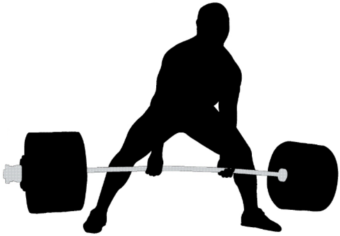
C. Deadlift
1. Rules of Performance
a)
Starting Position – One Minute Rule The bar must be laid horizontally in front of the lifter’s feet, gripped with an optional grip in both hands and lifted without downward movement
View page layout · 34
until the lifter is standing erect. The lifter will initiate or start the lift within one minute after the Head Official declares the bar is loaded. There is no signal given by the Head Official to start the execution of the Deadlift.
b)
Lifter’s Position in Regard to the Head Official The lifter shall face the Head Official in front of the platform.
c)
Position at the Completion of the Lift On completion of the lift, the knees shall be locked in a straight position and the shoulders held in an erect position (not forward or rounded). The shoulders do not have to be thrust back past an erect position.
d)
Official’s Signal at the Completion of the Lift The Head Official’s signal shall consist of the downward movement of the hand and the command “DOWN”. The signal will not be given until the bar is held motionless and the lifter is in the apparent finished position.
e)
Definition of an Attempt Any rising of the bar or any deliberate attempt to raise it shall count as an attempt.
f)
Use of Closed Grip Lifters must use a closed grip during the execution of the Deadlift. False or Suicide grips are not allowed in LHSPLA competitions.
2. Causes for Disqualifications
a) Any downward movement of the bar during the uplifting.
b) Failure to stand erect with the shoulders held in an erect position.
c) Failure to initiate the execution of the deadlift within a one minute period after the Head Official declares the bar is loaded and ready.
d) Failure to maintain locked knees by the lifter at the completion of the lift.
e) Supporting the bar on the thighs during the performance of the lift. (i.e. if the bar edges up the thigh but is not supported this is not reason for disqualification). The lifter should benefit in all decisions of doubt made by the official. NOTE: Supporting the bar is defined as a secondary bending of the knees and a dropping of the hips (hitching).
f) Stepping backwards or forwards. Rocking back and forth on the feet between the ball and heel of the foot is permitted though.
g) Lowering the bar before receiving the “DOWN” signal from the Head Official.
h) Allowing the bar to return to the platform without maintaining control with both hands.
View page layout · 35
i)
Making any attempt to lift the bar that allows it to rise and descend without having the plates themselves leave the platform. j)
Failure to use a closed grip during the execution of the lift.
V. Weighing In
A. LHSPLA 24 Hour Rule
The LHSPLA allows weigh-ins to occur at specified times the afternoon or night before any Regional competition and State Championship Meet. The Meet Director will be responsible for setting up weigh-in times and notifying each coach about these specified weigh-in times.
B. Duration of Weigh-In Sessions
1. Specification of Weigh-In Times at LHSPLA Meets
If specified on the entry blank, additional weigh-in sessions of any duration may be conducted during the 24-hour period before the lifting session begins: however, during the last 2 ½ hours before the start of the competition, a standard weigh-in session of 1 ½ hours will be used. This session will end 1 (one) hour prior to the start of the meet.
C. Weigh-In Procedure
1. Where and Who May Attend
At Regional and State competitions teams shall weigh-in all at the same time to expedite the weighing-in process and to help meet management to keep track of all teams entered in that particular competition. Only team members who have been designated to lift shall be weighed-in. Any individual lifter’s body weight shall not be made public until all lifters competing in the meet have finished weighing in.
**A listing of bodyweight category limits shall be posted near the scale.
It is recommended that electronic scales be utilized to correspond to the LHSPLA weight classes and that only the weight classes sanctioned by the LHSPLA are clearly exhibited at the weigh-in. This will avoid any confusion to the proper weigh-in class in case of a tie, and ensure an orderly process for weighing in.
2. Lifter Requirements
Lifters must be weighed in only wearing apparel, items, and accessories that can legally be worn on the competition platform. At a minimum, lifters must wear standard underwear (see III.F, III.G, and III.O for clarification). Properly-fitted singlets and socks are optional. The weigh-in procedure shall ensure that lifters are weighed in by officials, or knowledgeable non official representatives of their own sex appointed by the Regional Assignment Secretary or Director of Officials.
3. Who May Be Present at the Weigh-In
The only personnel that will be allowed in the weigh-in room or area at Regional and State Meets are:
View page layout · 36
a) the meet personnel who are conducting the weigh-in,
b) the team members who are listed on the team roster at Regional Meets and lifters from each respective team who qualify to lift at a State Meet, and
c) the head coach or his/her designee from the team that is currently being weighed-in. There are no exceptions. This is to ensure that all lifters are properly supervised, that the lifter correctly reports to the weigh-in official for his/her weight class, and that all necessary documents are executed for that lifter.
Male or female coaches with opposite sex lifters shall notify the weigh-in official immediately. There must be at least a 10 ft. buffer between the scale and the next person in line waiting to weigh-in.
D. Determining the Order of Lifting
In all LHSPLA meets the order of lifting in individual weight classes shall be determined by bodyweight. When two lifters in the same weight class are attempting the same weight; then the lifter with the lighter bodyweight will lift ahead of the heavier lifter attempting the same weight. If the two lifters have the same bodyweight, then the lifting order will be determined by alphabetical order.
E. Explanation of Officially Making Weight
1. Procedures to Follow if Weight is Made – Initial Expeditor Card
Each lifter may be (officially) weighed only once. Only those lifters whose body weights are heavier or lighter than the limits of the bodyweight category that they are trying to get into are allowed to return to the scales. After a lifter makes weight, the weigh-in official will write the lifter’s bodyweight in ink on their lifting card, then both he/she and the Official in charge of the weigh-in must initial his/her expeditor card in ink in the space provided. After doing so he/she must surrender the expeditor card to the Official in charge of that weigh-in. A second official stationed outside the weigh-in area will then re-check a team’s lifting cards with its head coach or his/her designee to ensure consistent application of the weigh-in procedure and to ensure accessibility inside and outside of the weigh-in area. The second weigh-in Official posted outside the weigh-in area shall require the team’s head coach or his/her designee to certify that the weights and weight classes on the cards for their team members are correct by initialing the lifter card in the space provided.
2. Lifter’s Responsibility When Making Weight
A lifter may try to make weight as many times as necessary until the weigh-in time expires. When a lifter does not want his/her weight officially recorded, the lifter is responsible to tell the official weighing in the lifters that they are simply checking their weight. The lifter is also responsible for telling the official weighing in the lifters that they are on the scale for an official recording of their body weight.
View page layout · 37
3. Illegal Re-Weigh
If a lifter enters a particular weight class, steps on the scales and officially makes weight within the upper and lower limits of the weight category, they will not be allowed to reweigh under any circumstances.
F. Weigh-Ins at Invitationals and Dual/Tri Meets
For the purpose of weighing in at Invitational and Dual/Tri meets Only
1. At Invitational and Dual/Tri Meets, teams may weigh-in all at the same time by an opposing team’s coaches or LHSPLA official, or opposing team’s school designee to expedite the weighing-in process and to help meet management to keep track of all teams entered in that particular competition. Only team members who have been designated to lift shall be weighed-in. Any individual lifter’s body weight shall not be made public until all lifters competing in the meet have finished weighing in.
2. It is recommended that electronic scales be utilized to correspond to the LHSPLA weight classes and that only the weight classes sanctioned by the LHSPLA are clearly exhibited at the weigh-in. These scales do not have to be certified but must be calibrated to weigh to 1 decimal place. The scale should be capable of weighing a person of at least 400 lbs.
G. A Lifter Is Too Heavy/Light for The Class Declared (Regional Competition)
A lifter who is too heavy or too light for the class entered may move into the next higher or lower weight class, provided that not more than one lifter from his/her team is already entered in that weight class. This will only be allowed at Regional Meets. At the State Meet a lifter must lift in the weight class that he/she qualified in at the Regional Meet.
H. When Lifters Have A Tie in Their Totals
1. Re-Weigh Procedures
If the two lifters register the same bodyweight at the weigh-in and eventually achieve the same total at the end of the competition, they will be re-weighed and the lighter lifter will take precedence over the heavier lifter.
2. Lifters Re-Weighing the Same
If both lifters weigh the same after re-weighing, they shall then share the placing and each will receive an award. The two lifters in question will tie for that place position in the competition and split the points for that place and the next order place for team points.
I. Scoring at All Meets
Weight classes at all meets shall be scored using the following guideline:
Division I – Class 5A (Boys/Girls) – 12-9-8-7-6-5-4-3-2-1 (1st through 10th place) Division II – Class 4A (Boys/Girls) – 12-9-8-7-6-5-4-3-2-1 (1st through 10th place)
View page layout · 38
Division III – Class 3A (Boys/Girls) – 12-9-8-7-6-5-4-3-2-1 (1st through 10th place) Division IV – Class 2A (Boys/Girls) – 12-9-8-7-6-5-4-3-2-1 (1st through 10th place) Division V – Class 1A, B and C (Boys/Girls) – 12-9-8-7-6-5-4-3-2-1 (1st through 10th place)
J. Lifter Information to Be Presented at the Weigh-In and Allowable Attempt Changes
1. Conventional Bar Progression
The lifter shall declare opening attempts for all three lifts (squat, bench press, and deadlift) at the time of the weigh-in. Lifters shall be responsible for checking their squat rack heights and foot blocks for the bench press prior to the start of the competition.
2. Minimum Acceptable Opening Attempt
The minimum acceptable opening attempt for all three lifts (squat, bench press, and deadlift) shall be 45 lbs.
K. The Rounds System as Recommended for LHSPLA Meets
1. Submission of 1st Attempts
First attempts for all three lifts shall be given at the weigh-in and can be changed within the last 5 minutes of the starting time of the meet or a flight. After the meet has started, the 5 minutes time period to change a lift before the starting time of the next flight is defined as any time before the end of the 3rd attempt of the flight currently being contested. **A lifter is permitted one change of weight on the first attempt of each lift.**
Submission of 2nd Attempts 2.
Next attempts for all three lifts shall be submitted prior to the start of the second or third round. If no attempt is given within 1 minute of the completed attempt, the lifter will be granted a 5 lb. increase on his next attempt. Should the lifter have failed his previous attempt and not submitted a weight for a further attempt within the one minute time allowance, then the bar will be loaded to the failed weight (2nd or 3rd attempts).
3. Attempt Changes in the Deadlift
Only the second and third attempts in the deadlift may be changed. **Each of these attempts may be changed twice.** The changes of weight may be higher or lower than the lifter’s previous submission, may not be lower than the lifter’s weight previously attempted, and the lifter must have one successful attempt before you can make change to the weight. However, these are only permitted provided that the lifter has not been called to the bar already loaded to his/her previously submitted weight. All attempts shall conform to increasing order when the attempts of two lifters are the same. After the expeditor has recorded the second or third attempt for the squat and bench press, it cannot be
View page layout · 39
changed. Lifters may select any increase in weight for their second and third attempts (5 lb. increase is the minimum).
4. Declare Next Attempts to the Expeditor
All attempts shall be given to the expeditor. All attempts shall be recorded with the expeditor prior to the start of a round. The last lifter in a round has a maximum of one (1) minute in which to submit his/her attempt without forfeiture.
5. Declaration of Attempt When Lifter Follows Himself/Herself
When it is apparent that a lifter will be following himself/herself from one round to another, the lifter shall be given 3 minutes to declare their next attempt. Then after the “bar loaded” command is given by the Head Official on the platform, they have one (1) minute to commence the execution of the lift when they follow themselves.
6. Repeat Attempts Procedure
All repeat attempts due to a scorekeeper’s error, misloading, or for any other reason shall be performed at the end of the round in which that error occurred. If the error occurs with the last lifter in a round, the lifter shall be given a three
(3) minute delay before repeating the lift.
7. Order of Attempts by Increasing Weight
All rounds shall be governed by the order of increase in weight: therefore, the lifting order will change from round to round. The order in lifting is always from the lightest to the heaviest weight, and with regard to a lifter’s bodyweight for duplicating attempts.
8. Allowable 2nd and 3rd Round Attempts
All attempts in the second and third rounds shall be equal to or greater than the previous attempts.
9. 5 lb. Increase
An increase of 5 pounds may be taken for any attempt.
VI. MEET OFFICIALS AND ORDER OF COMPETITION
A. Officials to be Appointed
1. By Regional/State Meet Director
a) Speaker/Announcer
b) Expeditor(s)
c) Scorers, Computer Operator
d) Spotters/Loaders
e) Overhead Expeditor
f) Platform Managers
View page layout · 40
g) Warm-Up Room Supervisor
h) Head Official-In-Charge, Officials i)
Weigh-In Officials j)
Records Processors
k) Marshall
B. Jurisdiction of Meet Officials
It is recommended that powerlifting officials shall take jurisdiction over all LHSAA/LHSPLA sanctioned meets once all officials have entered the meet area premises. From that point forward, all announcements regarding meet administration, coordination, and facilitation shall be conducted by the designated powerlifting official. This will ensure that pre-flight rules meetings, singing of the national anthem and/or pledge will be executed without interruption.
C. Persons/Officials Allowed on the Platform
1. During Competition on Stage/Platform
During the competition taking place on a platform or stage, only the lifter and his coach, the Official-In-Charge, Platform Officials, and the spotters/loaders will be allowed on or around the platform. During the execution of a lift, only the lifter, spotters/loaders, and the officials are permitted on the platform. Coaches shall remain outside the designated lifting area, and shall position themselves either at the back right or left corner of the platform during the lift.
2. Adult at Expeditor Table
There shall be at least 1 adult (high school graduate) at the expeditor table at all regional and state level competition.
3. Penalties for Supervision on Platform by Uncertified Coach
If anyone (adult or student athlete) other than a lifter’s coach is found on the platform area aiding/coaching a student athlete before, during or after the execution of an attempt, they will be asked to remove themselves from the platform and lifting area and move into the general admission seating. Any meet credentials (wristband/LHSPLA) will be surrendered to the meet director. Any subsequent violations by the same uncertified adult or student athlete will lead to their removal from the meet venue.
D. Persons/Coaches Allowed in the Wrapping Area
Only one coach and one wrapper shall be allowed per team to assist a team’s lifters in each platform wrapping area. This is to avoid the massive congestion in the waiting area, and allow more control and facilitation for the platform expeditor and meet workers.
E. Adjusting of Equipment While on the Platform
A lifter shall not wrap or adjust his/her costume while on the platform. The lifter may adjust his/her belt on the platform.
View page layout · 41
F. Progressive Loading of the Bar
In normal competition, the bar is loaded progressively and the lifter requiring the lightest weight is first in the lifting order. The weight of the bar, except in rare circumstances, cannot be reduced once a lift has been performed at that weight. It is necessary for a lifter or his/her coach to observe the progressive loading of the bar and be ready to make his/her attempt at the chosen weight. Use of the Round System allows quick and orderly loading of the bar and expedites the competition.
G. Order of Lifters Taking the Same Weight
1. Use of Bodyweight to Determine Lifting Order
When two or more lifters declare their wish to take the same weight, their lifting order will be determined by bodyweight (the lighter lifter will lift ahead of the heavier lifter taking the same attempt). If two lifters are taking the same weight and have the same bodyweight, their lifting order will then be determined by alphabetical order according to their last names. The bodyweight column must show one (1) decimal and not round to the nearest whole number. Officials and table expeditors must review the bodyweight on the lifting card to assure the lighter lifter lifts ahead of the heavier lifter taking the same attempt.
2. Attempt Priority Rule
When using the progressive loading system, a lifter taking his/her first attempt shall precede lifters taking their second and third attempts with the same weight. In the Rounds System, all first attempts are taken in Round One, second attempts in Round Two, and third attempts in Round Three.
H. Minimum Amount of Weight Increase Between Successful Attempts
1. Standard Procedure
In LHSPLA recognized competitions, the weight of the barbell shall always be a multiple of 5 pounds. All record attempts must exceed the current record (A lighter bodyweight with the same bar weight will not claim the record). The progression must be at least 5 pounds between successful attempts.
2. Allowance of Record Attempts
LHSPLA records can only be officially attempted or broken at the North, South, East, West, Central, and Bayou Regional Meets and at the LHSPLA State Championship Meets. An athlete who breaks a record must post a total.
3. State Records – Simultaneous Breaking of Records at Different Regions
In all cases the lighter lifter shall acquire the record. At the respective regional meets, it shall be made clear that all records are not final until all calculations and reconciliations have been completed, and in no case, shall this announcement be made publicly. This should be noted in the business meeting with the coaches. This point becomes moot at the State Meet level of competition.
View page layout · 42
I. Loading Errors and Incorrect Announcements by the Announcer
1. Responsibility for Corrective Action
The Meet Director or the Head Official-In-Charge shall be responsible for corrective action when loading errors or incorrect announcements by the Speaker occur. His/her decision will be given to the speaker who shall make the appropriate corrected announcement.
2. Examples of Errors in Loading and Proper Correction Measures
a)
Bar is Loaded to a Lighter Weight If the bar is loaded to a lighter weight than requested by the lifter:
If the lift is successful:
(1) The lifter may accept the attempt, or
(2) The lifter may take the attempt again at the proper weight.
If the lift is not successful:
(1) The lifter shall be granted an additional attempt at the originally requested weight. The attempt will be given at the end of the Round.
b)
Bar is Loaded to a Heavier Weight If the bar is loaded to a heavier weight than originally requested:
If the lift is successful:
(1) the lifter shall be granted the attempt. The weight on the bar shall be reduced if subsequent lifters require a lesser weight.
If the attempt is not successful:
(1) the lifter shall be granted an additional attempt at the originally requested weight. The attempt will be given at the end of that particular Round.
c)
Displacement of Bar or Equipment on Platform Whether or not the loading on each side of the bar is correct, any change occurs on the bar or discs during the execution of the lift, or the platform is disarranged:
If the lift is successful:
(1) The lifter may accept the attempt or elect to take the attempt again.
If the attempt is unsuccessful:
(1) The lifter shall be granted a further attempt at the end of the round.
View page layout · 43
d)
Speaker Error If the speaker makes a mistake by announcing a weight lighter or heavier than requested by the lifter:
(1) The Meet Director or Head Official-In-Charge shall be solely responsible for taking action.
e)
Bar is Misloaded If a lifter misses his/her attempt because the speaker omitted announcing his/her at the appropriate weight, the weight shall be reduced as necessary and the lifter shall be allowed to take his/her attempt at the end of that particular round.
f)
Lifter Lifts Out of Order by Own Fault If a lifter lifts out of turn by their own fault or accord, the result will automatically be a no lift. In no way should a reattempt be given.
g)
3rd Attempt Deadlift If a lifter is granted a relift for any reason, the lifter must follow him/herself.
J. Disqualification for Failure to Successfully Make an Attempt in Each of The Three Contested Lifts
Three unsuccessful attempts in any lift will automatically eliminate the lifter from the competition and the lifter shall not be allowed to continue participating in the meet. Any records set shall be null and void.
K. Allowable Spotter Aid
Other than the initial removal of the bar from the rack, the lifter shall not receive any verbal or physical help from the spotters/loaders in positioning himself/herself for an attempt.
L. Lifter Time Allotment for Removal from The Platform Following an Attempt
At the completion of an attempt, the lifter shall leave the platform within 30 seconds. Failure to comply with this rule may result in disqualification of the attempt at the discretion of the officials.
M. Disqualification Procedure for Misconduct
1. Conduct That Discredits the Sport
Any coach, assistant coach, or lifter, who by reason of his/her misconduct within the lifting area that discredits the sport, shall be subject to disqualification based on the majority decision of the Officials on the platform. Any misconduct by a coach, assistant coach, or lifter that occurs
View page layout · 44
outside of the lifting area can be given a warning upon agreement of the 3 judges. A second offense will be an automatic disqualification. The team coach or school representative shall be officially informed of the disqualification. The disqualified coach, assistant coach, or lifter must leave the competition area. In any event that subjects a lifter to disqualification on the platform there must be a unanimous agreement between platform officials that the lifter engaged in misconduct or Profanity.
NOTE: If a lifter is disqualified from the meet the Head Official is required to mark “DQ” on the lifter’s card, sign or initial the lifter’s card, and take it from the table and give it to the Meet Director as soon as possible.
No team shall be disqualified because of actions by a lifter. However, if two or more lifters commit misconduct or incites other team members to commit misconduct, the entire team shall be warned of such misconduct. In any of the above cases, the misconduct shall be documented and reported to the school’s principal for further action (LHSAA Sportsmanship Rules).
2. Contact Above the Neck and Shoulders
Slapping or hitting a lifter above the neck and shoulders, by use of the hand or any other object, will not be allowed. Any conduct or actions of this nature can lead to disqualification of a lifter or coach.
N. Appeals or Complaint Procedure
1. Rule for Presentation of Appeals or Complaints
All appeals against an official’s decisions, complaints regarding the progress of the competition, or complaints against the behavior of any person or persons taking part in the competition shall be made in writing to the Head Official-In-Charge or the Meet Director. The Head Coach of the team shall lodge the appeal or complaint. This shall be done immediately following the action for which there is a complaint or appeal.
2. Head Official or Meet Director’s Authority for Formal Complaints
If deemed necessary, the Head Official or Meet Director, and the LHSPLA Executive Committee members present may temporarily suspend the progress of the competition and retire to consider a decision on a Formal Complaint. The Head Official, Meet Director, and the LHSPLA Executive Committee may enlist the help of the Head Officials from each platform to consider the complaint.
Once a decision has been made, it shall be considered final and there will be no right of appeal.
All decisions, rulings, or judgments by platform officials involving or relating to whether a lifter has complied with rules of performance are not appealable. The only appealable matters are those related to misloads, lifting order, clerical errors on overheads/expeditor sheets or lifting cards or complaint against the
View page layout · 45
behavior of a person, persons, or team either taking part in the competition or person or persons associated with a team in the competition or warm-up area.
Any appealable matter described above, or complaint, must be immediately lodged in writing to the Head Official on the platform following the action.
O. Break Time Between Each Contested Lift
A compulsory break of 5 minutes shall take place between the completion of one lift and the commencement of another (i.e. between the squat and the bench press and between the bench press and the deadlift).
P. Recommended Size of Flights Using the Rounds System
1. Number of Lifters in a Flight
When using the Rounds System, the number of lifters in a flight shall be determined by the Meet Director with a recommended maximum of 15 lifters in a flight at any invitational/tri meets, regional championships, but a mandatory maximum of 15 lifters at state championships.
2. When Fewer than 10 Lifters are in a Flight
When fewer than 10 lifters are in a flight, it may be necessary to add time to the flight one minute for each vacancy below 10 lifters will be added to the end of the flight to give the participants in the small flights ample time to recover and to prepare for the next attempts.
VII. Officials
A. Jurisdiction of Meet Officials
It is recommended that powerlifting officials shall take jurisdiction over the meet once all officials have entered the meet area premises. From that point forward, all announcements regarding meet administration, coordination, and facilitation shall be conducted by the designated powerlifting official. This will ensure that pre-flight rules meetings, singing of the national anthem and/or pledge will be executed without interruption.
B. Duties of the Head Official
The Head Official is responsible for giving the necessary signals for all three lifts, and is in charge of the platform and all decisions regarding loading errors.
C. Procedure for Announcing the Platform Officials’ Decision
Once the bar has been replaced in the rack or on the platform at the completion of the lift, the officials will announce their decision by activating the lights.
White for a good lift, and red for no lift.
D. Signals for the Three Lifts
| Lift | Commencement | Completion |
View page layout · 46
| Squat | A visual signal consisting of a downward movement of the arm together with the audible command “SQUAT”. | A visual signal consisting of a movement of the arm towards the official with the audible command “RACK”. |
| Bench Press | A visual signal consisting of a downward movement of the arm together with the audible command “START”. During: The audible command “PRESS” after motionless at the chest, and the visual signal of an upward movement of the arm. | A visual signal consisting of a movement of the arm towards the official together with the audible command “RACK”. |
| Deadlift | No signal required. | A visual signal consisting of a downward movement of the arm together with the audible command “DOWN”. |
| ***When a lifter fails to complete a Squat or Bench Press, the command is “RACK”. |
E. Unwitnessed Lift
Recommended procedure when an Official is inadvertently prevented from viewing the lift in progress:
1. During the lift, if a spotter(s) unintentionally gets in the way of an official’s view of the lift so that he/she does not actually see the lift, the official should give the lifter a white light and warn the spotter.
F. Duties of the Officials
1. During the Contest
During the contest the Officials shall assure that:
a) The weight of the loaded bar agrees with the weight announced by the speaker or the weight shown on the overhead. Each platform shall be supplied a loading chart for officials.
b) While on the platform, the lifter’s costume and personal equipment are legal and within the rules in Section III.
View page layout · 47
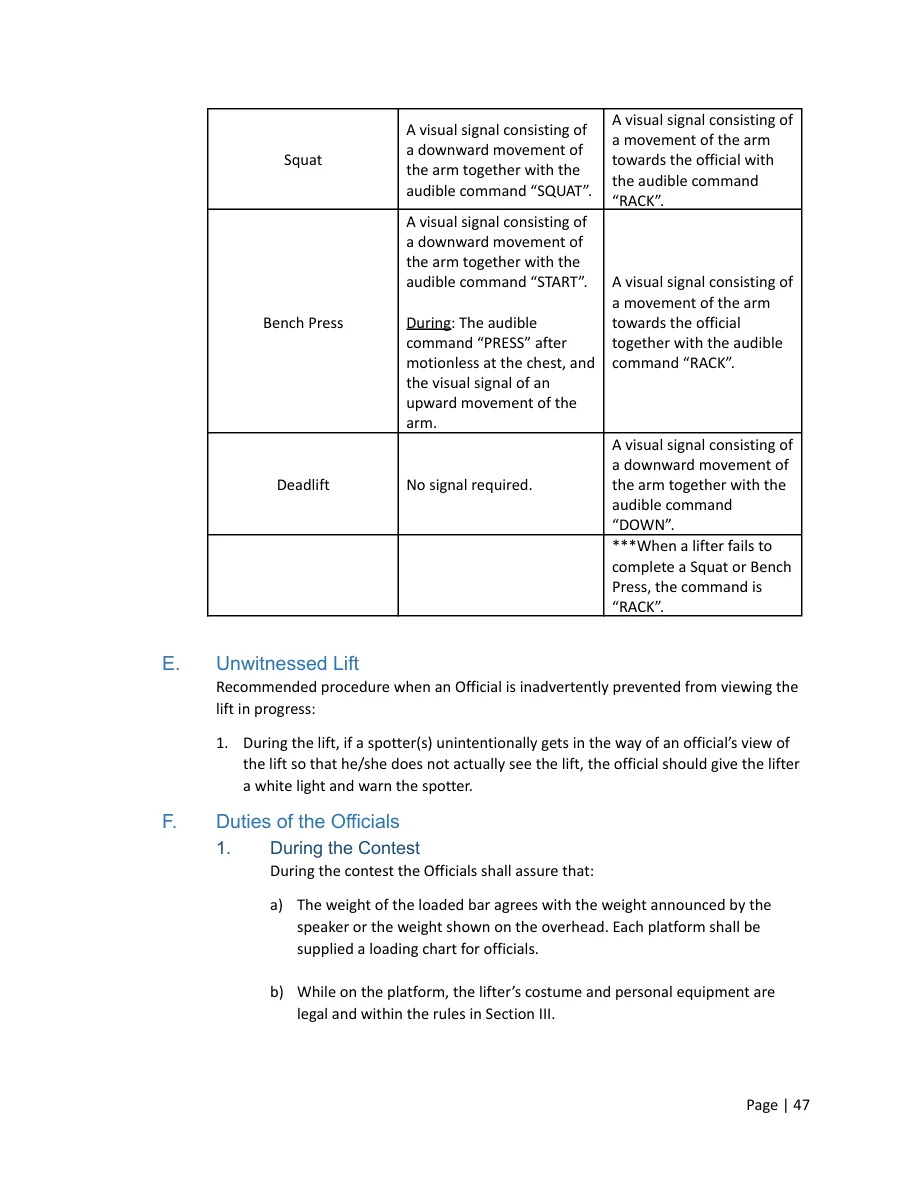
G. Lifter Notification of Infraction(s)
If a lifter receives a red light(s) for a lift, the lifter may send his coach or go in person to the Head Official and request the reason for the red light(s). The Head Official shall investigate and inform the lifter or coach why the red light(s) was given. A lifter requesting additional information to the Head Official’s investigation and response must immediately leave the platform and go to the Head Official-In-Charge for further clarification.
H. Non-Influence of Officials Toward Each Other
An Official shall not attempt to influence the decisions of the other officials. They shall not veto or overrule each other. For apparent reasons, all three official’s lights shall be activated at the same time.
I. Acceptable Official Communication
The Head Official may consult with the side officials, Head Official-In-Charge, or any other official as necessary to expedite the competition, or to correct faults. There shall be absolutely no communication between officials and parent(s) unless the coach is a parent. This conduct is unprofessional, and only invites unnecessary and potential conflicts. If a coach has a question, the issue should be addressed by the Head Official after discussion with the Side Officials out of the presence of the coach and/or lifter who has raised the issue.
J. Official’s Duties After the Competition
After the competition, the three officials shall sign the official score sheets, record certificates, and any other documents requiring a signature.
K. On-Deck Official’s Inspection
Visual inspection of lifters in the On Deck area will be done by an official appointed for this purpose. No lifter who is preparing to lift after his name has been called should be stopped from lifting due to alleged attire or equipment violation or a score keeping error. A lifter should be warned after completion of the lift for a minor attire infraction. A lifter’s second attempt will not be allowed if they are found to have committed the same minor infraction. If a lifter is guilty of the same minor infraction on their 3rd attempt, meet management has the right to disqualify said lifter from the meet. If a lifter has committed a major attire or equipment violation, the lift will be disqualified. If a lifter commits a second major attire or equipment violation, meet management has the right to disqualify said lifter from the meet.
L. Timekeeper – Duties
The sole concern of the Timekeeper (platform expeditor) is the accurate running of the clock. The clock is not started until the Head Official signals that the bar is loaded and ready, and the lifter has been called to the platform. If a lifter follows himself/herself at the end of a round, three (3) minutes shall be given with warning at two (2) minutes and one (1) minute. After the three (3) minute period is over the lifter has a one (1) minute time frame to initiate the execution of a lift (Squat, Bench and Deadlift) that is outlined in Section IV of this rulebook, The Powerlifts and the Rules of Performance. If the
View page layout · 48
Timekeeper sees that the lifter is apparently unaware of time running out, it is permissible to communicate to the lifter how many seconds remain.
View page layout · 49